Generating manufacturing leads isn’t as easy as it sounds. Your buyers are engineers, sourcing managers and plant managers who are evaluating suppliers discreetly, often well before they issue an RFQ. When the RFQ arrives in your inbox, the pool may have already been narrowed down.
Referrals, trade shows and cold calls still matter, but relying on them alone limits how many target accounts ever hear from you. This guide to lead generation for manufacturing companies covers twelve practical strategies, how to choose between them, and how to measure what produces qualified manufacturing leads.
Reasons Lead Generation Is Important for Manufacturing Businesses
Sales in manufacturing are seldom linear. Four must-fly truths drive each campaign:
With processes like supplier approval, sampling and quality audits, some deals can take months to complete.
Decision makers on the deal: Engineers review specs, purchasing compare price and terms, business leaders agree to the risk.
A buyer looking for a particular alloy, tolerance or certification would disregard generic messaging.
A request for a price list is not an OEM with a defined requirement, volume and schedule.
In other words a good plan is to centre your activity less on gaining enquiries and more on drawing in buyers whose requirements, dates and volumes line up with your ability to deliver.
12 Strategies That Work for Manufacturers
1. Optimise Your Website for Manufacturing Buyers
This is the home page of all your other channels, so it has to have the answers to buyer questions quickly. Content capability pages including details of materials, tolerances, equipment, quality certification (ISO9001 and comparable) and typical lead times. Include an RFQ form to gather part specifics, volume and drawings so the sales team can assess fit first.
2. Invest in SEO For Industrial and Product Specific Search
Buyers are specific when they search, more a process plus a material plus an industry. To find these long-tail searches, create dedicated product and process pages for target terms rather than one generic services page. Tackle technical fundamentals like page speed and crawlability. Specialist B2B SEO services can help prioritise terms with real purchase intent. SEO is slow but additive, perfect for companies with a steady product range.
3. Develop Industry-Specific Landing Pages
An automotive buyer and a medical device buyer are interested in very different factors. One is cost per part at volume, the other needs traceability and compliance. Build a landing page for each of the industries you serve, include the standards relevant, example applications, and one call to action. These pages also provide a dedicated landing point for paid and email campaigns.
4. Leverage LinkedIn to Target Manufacturing Professionals
Profile the key players who influence decisions: target by job title, plant location or sector. Use a company page to publish shop-floor or customer updates, latest innovations and technical tips. Maintain contact before you try to sell, so you’ve opened the door with something of interest, not a brochure.
5. Use Account Based Marketing (ABM)
Sending a copy to everyone for big value deals is a waste of time. Use account-based marketing and start with a short list of those buying groups you are qualified to supply (OEMs etc). Map each buying group and then contact the accounts by role eg:technical proof for engineers, reliability and terms for procurement ABM is ideal for long high-value deals.
6. Run Targeted Google Ads Campaigns
Paid search wins buyers on a deadline. Bid on pure-intent terms, add negative keywords like “job” and “hobby,” promote to a landing page related to the search query and focus your location targeting to markets you can serve. Count RFQ submissions as conversions and measure campaigns byqualified leads – not clicks. Paid search works for manufacturers who require results within the timeframe SEO can’t match.
7. Publish Technical Content and Educational Resources
Engineers rely on content to inform their decisions. Write a material selection guide, design-for-manufacturing checklist, application note, process comparison, or digital downloadable spec sheet that solves the questions your sales engineers get asked all day. Gate only your most precious content and leave the rest accessible so search engines and AIs can discover it.
8. Use Case Studies to Demonstrate Manufacturing Expertise
Clients need to see that you have the capability to resolve issues similar to theirs. Divide each case study into challenge, solution and result, identifying the component, material and process. Use only those results that the client authorizes, and use an anonymized version if you need a non-disclosure agreement. A handful of case studies per sector is worth more than a long list of client names.
9. Create Personalized Email Marketing & Lead Nurture Campaigns
As manufacturing cycles tend to be lengthy, few people are available when they first ask for information. Slice your list according to role and industry, then follow up with valuable information such as a new certification, expansion of capacity or a pertinent case study. Initiate a brief sequence after each RFQ or download. Vary frequency appropriately.
10. Participate in Trade Shows and Industry Events
Trade shows continue to provide direct access to engineers and procurement reps. Challenge them by scheduling meetings with target accounts in advance, recording feedback on each call, then calling back within a week. They are well suited for relationship-driven, high-value sales, but miss the mark if there’s no drive to follow up.
11. Increase Your Exposure on Suitable B2B Directory Sites
Manufacturers head to directories like Thomas Net or IndiaMART to find a supplier. Don’t only be listed; use detailed categories, certifications and photos of the range of products you sell. Respond promptly to enquiries. Not all leads convert into quotes, so monitor your listings’ performance and only spend more when you receive true leads. Best for products with categorical demand.
12. Integrate CRM and Lead Scoring to Get Better Follow-Ups
Once the lead is in the system, it can be lost. Leverage your CRM to track any RFQ so that marketing and sales communicate from the same source. Keep the record constantly up-to-date through lead scoring based on the lead’s job title, company fit, project size and activity, e.g. if the visitor has viewed information pages on your site more than once. This allows sales to prioritise the sales funnel.
Inbound vs Outbound Lead Generation for Manufacturing Businesses
Inbound and outbound solve different problems. Inbound builds visibility so buyers find you when they start searching, while outbound lets you approach target accounts that are not searching yet.
| Inbound Lead Generation | Outbound Lead Generation |
| Attracts buyers through SEO, blogs and website content | Reaches prospects through email outreach and LinkedIn |
| Captures existing search interest | Approaches selected target accounts |
| Builds long-term organic visibility | Supports direct prospecting |
| Encourages enquiries from interested buyers | Initiates conversations with potential buyers |
Most vendors require both. Inbound platforms like SEO & technical content engage buyers who’re already studying vendors, and outbound enables you to start talking to named OEMs earlier of their shopping journey. They reach all levels of the buying process.
How to Choose the Right Manufacturing Lead Generation Strategies
You aren’t required to have all twelve. Select those which apply to you:
- Target industries: A handful of named OEMs favours ABM and LinkedIn, while a broad market favours SEO and directories.
- Product complexity and deal value: Complex, high-value products need tech content and case studies. Off the shelf parts lend themselves to SEO, paid search and directories.
- Buyer participation: Engineers seek technical assistance, procurement teams seek specifications, certifications and RFQ-ready pages.
- Sales cycle: The bigger the cycle, the more you need to nurture email-ers and follow-up with CRM.
- Budget and resources: Keep it simple by starting with just two or three channels that you can sustain. If you’re short on internal resources, B2B demand generation can give you a boost.
How to Measure Lead Generation Performance in Manufacturing
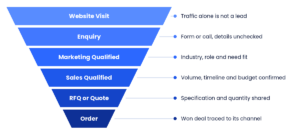
You’re seeing activity, not business impact. Measure these instead:
-
- Qualified leads and RFQs: Quote requests within your service(Your capability)
MQLs and SQLs: marketing-approved leads and sales-accepted leads - Lead-to-opportunity conversion rate
- Qualified lead cost
- Pipeline generated by each channel
- Qualified leads and RFQs: Quote requests within your service(Your capability)
Make sure every RFQ records its source, so revenue can be traced back to a channel. Compare channels on pipeline, not volume. A directory that sends fifty enquiries but no quotes is weaker than ABM that produces two RFQs from target accounts.
Conclusion
When digital presence, proactive outreach, valuable content and frequent follow-up are equally effective, products gain more quality inquiries. They can’t do it all on their own.
Keep “specifically” in that oxper is a B2B marketing partner that can help your company increase digital visibility and attract relevant opportunities. Learn more about oxper B2B digital marketing services and discover how it might align with your growth strategy.