What is B2B sales? B2B sales is the process of selling a product or service to another business. Unlike convincing an individual consumer, B2B sales involve selling to groups of decision makers who balance the order of importance between cost, risk and potential value.
That difference influences deal size, timeframes and the very process of selling. In this guide: Understand how B2B sales operates, how it is organized, the process and strategy, SaaS selling and today’s challenges.
How Does B2B Sales Work?
A seller searches out companies that match their ideal customer profile (ICP), persuades the purchasing decision makers, and pushes them to create a contract. According to Gartner, a complicated B2B buying group consists of six to ten buying decision makers, and so there is no one-enthusiastic contact who makes the sale.
Most buyers also prefer to take charge. According to a 2026 Gartner poll, while 67% of B2B buyers wanted to receive a rep-free experience, 69% relied on sales reps to confirm insights from AI. Now the salesperson’s role is to be a guide, not a parrot.
It’s useful to organize similar functions. Marketing is used to drive the awareness, lead generation captures the interested, and b2b demand generation services create the intent behind both. Then, sales converts the willing into signed-up customers.
B2B Sales vs B2C Sales
| Factor | B2B Sales | B2C Sales |
| Target audience | Companies, departments, institutions | Individual consumers |
| Decision-making | Multiple stakeholders, formal approvals | Usually one person or household |
| Sales cycle | Weeks to many months | Minutes to days |
| Purchase value | High, often contract-based or recurring | Lower, typically one-time |
| Relationship | Consultative, long-term, account-managed | Transactional, brand-driven |
Types of B2B Sales
- Supply and manufacturing sales: raw materials, components or equipment sold for production, such as a steel supplier selling to an auto parts maker.
- Wholesale and distribution sales: finished goods sold in bulk to retailers or distributors.
- Services and software sales: consulting, logistics, IT services and SaaS subscriptions.
Delivery models vary too: inside sales (remote), field sales (in person), channel partnerships and self-serve digital purchasing.
What Is the B2B Sales Process?
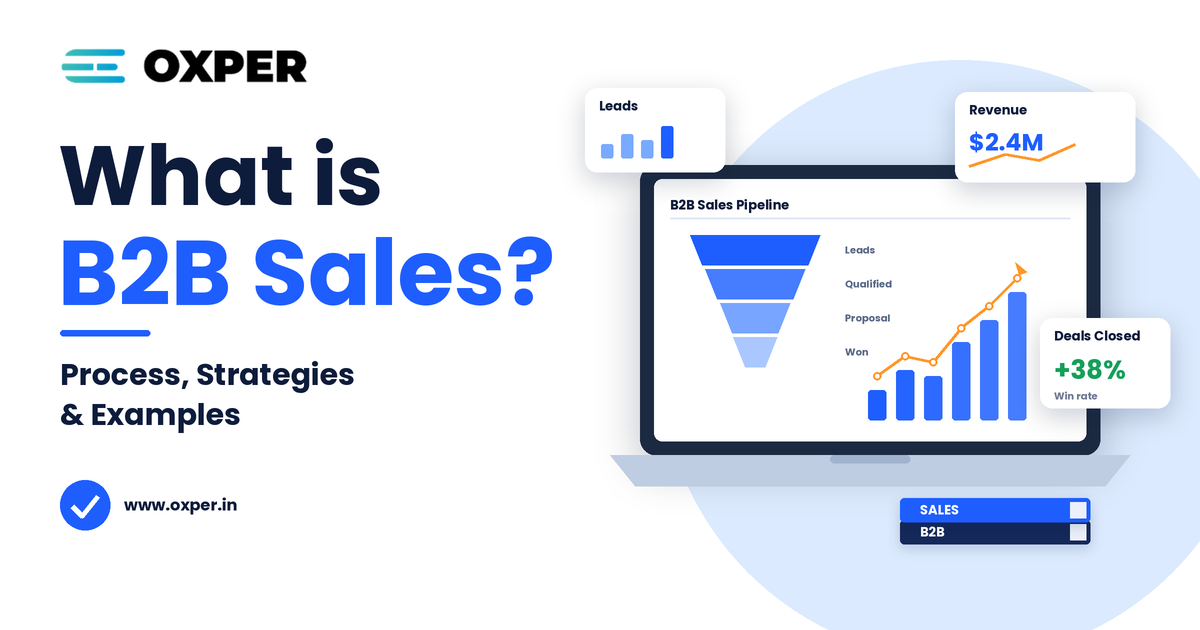
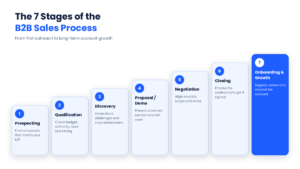
Every business adapts it, but most B2B sales processes follow these stages:
| Stage | What Happens | Purpose |
| Prospecting | Researching and contacting companies that match your ICP | Build a pipeline of relevant accounts |
| Qualification | Checking budget, authority, need and timing | Focus effort on winnable deals |
| Discovery | Mapping challenges, goals and stakeholders | Position the solution around real problems |
| Proposal or demo | Presenting a tailored solution and business case | Show measurable value |
| Negotiation | Discussing pricing, scope, terms and risk | Resolve objections and reach agreement |
| Closing | Contract review and signature | Convert the opportunity into revenue |
| Onboarding and expansion | Implementation, support, renewals, upsell | Retain the customer and grow account value |
What Is a B2B Sales Strategy?
A B2B sales strategy is a document that states: Who you sell to What your process will be Why your prospects should buy from you How your strategy should be successful. Good strategies tend to include:
A sharp ICP: clear firmographic & need-based criteria.
Multi-threading: involving finance, operations and end users, not only one champion.
Value-selling: putting a number value on the value-for example, cost savings or time to delivery.
Sales & marketing alignment: agreed-upon criteria for a qualified lead.
Account-based marketing balances specialised contact efforts with sales activity in high-value accounts. For instance, a logistics software company might decide to focus on 40 mid-market manufacturers and craft a different message for each to plant managers and CFOs.
What Is B2B SaaS Sales?
What does B2B SaaS sales mean? What is B2B SaaS sales? It’s the sale of a subscription-based software as a service to other companies. Since the recurring revenue model drives B2B SaaS sales, retention is just as important as the acquisition.
Common elements include free trials or demos, product-led and sales-led motions, “land and expand” growth, and deep working relationship with customer success. Teams monitor activities on ARR, churn and sales cycle.
What Is B2B Sales Experience?
What does B2B sales experience mean? There are two definitions.
In business, it is a record of selling to companies as a sales development rep, account executive or account manager. Hiring managers require prospecting, discovery, negotiation and stakeholder management abilities.
As a buyer, it’s how simple and reliable the buying process feels, from content and demos to pricing transparency and followup. Smooth interactions on both sides land the deal.
Typical B2B Selling Challenges
Long cycles, frozen deals: lots of deals that end with “no decision” because buying groups cannot come to a consensus.
Confusing prospect details: providing irrelevant info to the client group, leading to inaccurate lead scoring.
Buyer conflict: In Gartner’s May 2025 survey, 74% of buying teams reported experiencing toxic conflict.
Contradictory messaging: 69% of buyers receive inconsistent messages between a seller’s website and what reps communicate.
How Can Businesses Improve B2B Sales Performance?
- Explain what ICP is and how to score leads based on fit and intent.
- Provide reps with case studies, ROI evidence and messaging for different stakeholders.
- Make your website and sales conversations consistent.
- Use a CRM to track all contacts in the buying group.
- Review win/loss data and refine qualification quarterly.
B2B lead generation agency can deliver a quantity of better-qualified conversations on the internal capacity is constrained, and help reps focus on selling rather than prospecting.
Conclusion
So, what is B2B sales? It is a relationship-led, multi-stakeholder process of helping one business solve a problem for another, from the first outreach to renewal and expansion. Unlike consumer selling, success depends on understanding the buying group, proving measurable value and staying consistent across every touchpoint.
Teams that qualify leads rigorously, align sales with marketing and treat onboarding as part of the sale tend to close more deals and keep customers longer. Buyers now research independently and use AI before they ever speak to a rep, so the sellers who stand out are the ones who add real clarity, not just information.
A practical way to start: define your ICP, map the buying group for your top accounts and compare your pipeline stages with the process above. Even one or two of these changes can shorten sales cycles and make your B2B sales efforts more predictable and scalable.