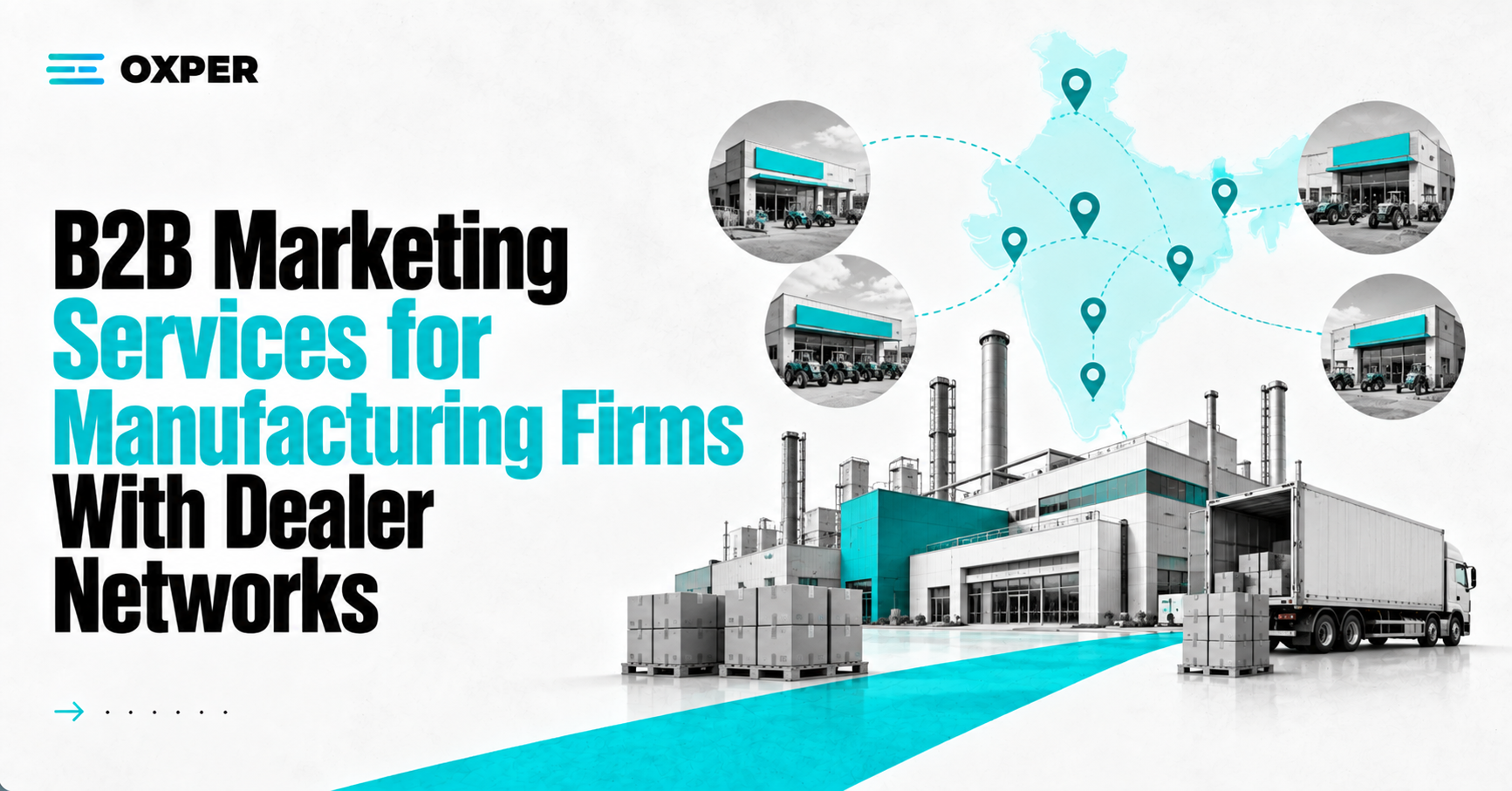
B2B Marketing Services for Manufacturing Firms With Dealer Networks
A manufacturer can have a strong product, an experienced sales team and a wide dealer network, yet still struggle to turn marketing into a predictable pipeline. The problem is rarely reached alone. Leads come in from different regions, dealers follow up at different speeds, and the brand often has little visibility once an enquiry is passed on.
That is where B2B Marketing Services must do more than generate traffic. For dealer-led businesses, marketing has to create demand, identify where each opportunity belongs and help channel partners move it forward.
Why Dealer-Led Manufacturing Demand Is Different
In a direct sales model, the process is more transparent. Marketing generates interest, and sales follow up on leads. The manufacturer should manage the issue of brand positioning, campaign strategy, data collection, and analysis. Dealers only need qualified prospects, relevant sales materials, and a degree of local autonomy in closing the deal.
This is also why industrial marketing cannot rely on generic brand promotion. Technical purchases involve more proof, more stakeholders and longer evaluation. Marketing has to reduce uncertainty, not simply create awareness.
What B2B Marketing Services for Manufacturing Must Solve
For manufacturers with channel partners, three things matter most: generating the right demand, routing it intelligently and keeping enough visibility to improve conversion.
Start With Buyer Problems, Not Product Lists
A lot of industrial websites are like catalogues. They talk about products, but not about their significance for the potential customer.
Winning campaigns start with the needs of the business: decreasing downtime, increasing productivity, ensuring better-performance equipment, creating a regulatory environment, or cutting expenses. SEO can take care of these searches, LinkedIn can get in touch with the technical market, paid search can cover the demand, and case studies can serve as an evidence for the customers.
That is what makes b2b manufacturing marketing useful. It connects technical capability to a commercial reason to act, which is the core of effective b2b manufacturing marketing.
Route Leads Without Losing Control
Generating an enquiry is only the beginning. Who gets it? How quickly should they respond? What happens if a dealer does not follow up?
A practical dealer network marketing strategy should define lead ownership by geography, product line, industry or dealer capability. CRM workflows and marketing automation can then support assignment, reminders, nurturing and status reporting.
Done well, b2b marketing for manufacturers gives dealers better opportunities while giving the manufacturer a clearer view of what happens after handoff.
Use ABM for Accounts That Deserve More Attention
Leads are not equally valuable. A company operating a local workshop and another one involved in national infrastructure may be looking for the same solution but should have different marketing approaches.
With Account Based Marketing approach, manufacturers can concentrate on high-value companies. The central marketing team can create tailored messages and campaigns, while a local dealer or a regional team will handle local affairs.
This approach suits industrial marketing particularly well because buying groups often span procurement, engineering, operations and management. Instead of asking dealers to hunt broadly, the manufacturer can give them priority accounts, useful context and coordinated campaign support.
Make Dealers Part of the Marketing Intelligence Loop
Dealers know what is happening on the ground. They hear objections, see competitor activity and know which industries are asking for quotations.
A strong dealer network marketing strategy captures that information. Those insights can shape landing pages, SEO topics, sales collateral and campaigns.
It also makes manufacturing marketing more relevant by region. A national proposition may stay consistent, but the message can change depending on the local industry mix, buyer pain points and product demand.
Measure Opportunities, Not Just Enquiries
Lead volume is an easy metric to celebrate. It is not always a useful one.
Manufacturers should track dealer acceptance rate, follow-up time, qualified opportunities, quotation value and conversion rate. These measures show whether marketing is creating commercial movement or simply activity.
A campaign producing 30 well-qualified enquiries may contribute more to revenue than one producing 150 weak leads. Good B2B Marketing Services make that distinction visible.
How Oxper Can Support Dealer-Led B2B Growth
Oxper brings together Account Based Marketing, B2B demand generation, lead generation, SEO, social media marketing, website design and related digital capabilities under one strategy. The agency also lists experience across industrial machinery, machinery manufacturing, chemical manufacturing, packaging and automation sectors.
For manufacturers, that integrated model matters. SEO, paid campaigns, ABM, landing pages, lead generation and dealer follow-up should work as one system.
Rather than treating every channel as a separate project, Oxper can help build one growth system around target markets, priority accounts and the dealer network.
Build Demand Your Dealers Can Actually Convert
Manufacturers do not need marketing that competes with their dealers. They need marketing that makes the network more productive.
The right B2B Marketing Services can create demand centrally, give channel partners stronger opportunities and help management understand what happens after a lead arrives. When data, content, automation and dealer execution work together, the network becomes easier to scale.
If your campaigns are generating activity but not enough dealer-ready opportunities, speak with Oxper about building a connected B2B growth strategy.