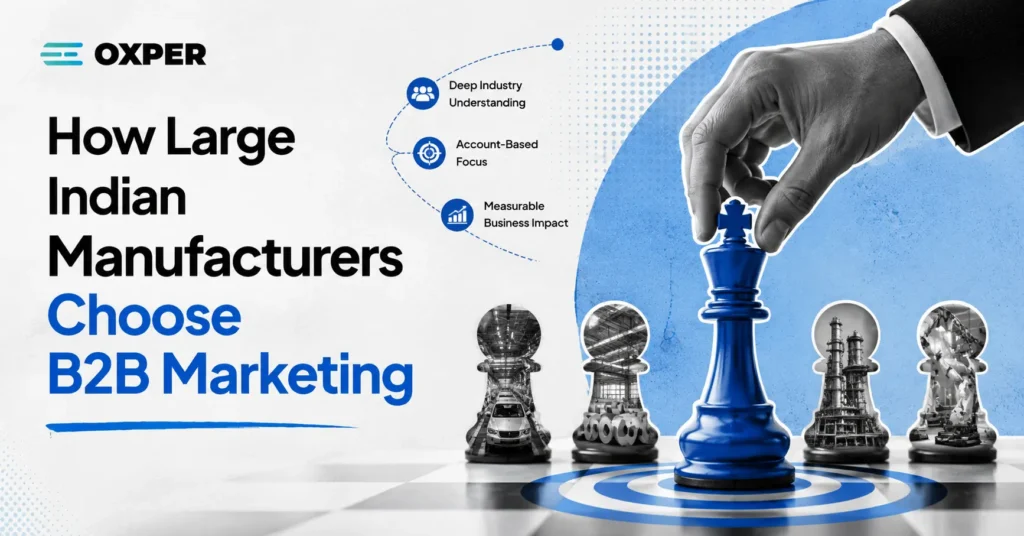
India’s manufacturing sector is projected to reach the $1 trillion target by 2025-26. Different scale. Here comes the uncomfortable side of it: most of the manufacturers driving this number to reach now operate pipelines that resemble those which were in place a decade ago – trade shows, distributor references and a sales team armed with business cards.
The industrial buyer, in the meantime, went online. For instance, the procurement director who is in the process of selection of automation companies will start her search on Google. The engineer comparing permeability membrane suppliers will read at least three technical blogs before picking up the phone to make the first call. The CFO will check LinkedIn even before the first appointment is granted.
And precisely this disconnect between online buyers and offline sellers makes B2B marketing decisions one of the most significant decisions the leadership teams of manufacturers have to make within the decade. In case the decision is made correctly, the manufacturer creates a solid pipeline which is invisible to competitors. And if it is made wrongly, it results in creation of a very expensive brochure firm.
This guide explains how large manufacturing companies in India make the decision using their internal processes for evaluation, criteria, channels which help to create a pipeline as well as choose between a specialized B2B Marketing agency and a general B2B marketing.
Why B2B Marketing Is Now a Board-Level Priority for Manufacturers
The traditional path of industrial buyers has now been turned upside down. In the past, your sales team would have been the ones to inform the buyers. Nowadays, procurement specialists, managers in charge of production, and engineers carry out most of their research about suppliers on their own – be it looking for information on Google, searching and browsing through the LinkedIn network, comparing specifications or making lists of competitors. By the time you get a call, the list of suppliers is already prepared, and the only task is to find out whether you would feature in it.
The role of the AI is getting bigger. Various industry studies show that almost 65% of B2B buyers who rely on AI technologies make their decisions quickly now – instead of spending weeks on getting vendor overviews, they prefer asking Chat GPT and Perplexity for short analyses of suppliers. The importance of this fact is that the shorter sales cycles provide fewer chances to enter the deal late enough. There were times when the business could afford being blind at the start of the sales journey, and when the revenue was seen only as an additional benefit.
Today, modern production enterprises treat B2B marketing as a means of revenue collection and not a cost centre that is going to produce catalogues. Having a solid marketing presence and greater revenue-generating capabilities is now considered to be the most important source of competitive advantage.
The Unique Marketing Challenges Indian Manufacturers Face
Many old-timers would agree that when it comes to B2B marketing, manufacturing could be one of the toughest environments to operate in India, with sales cycles lasting anywhere between six and 18 months, contractors being more than four in number, purchases being made purely on the basis of specifications rather than emotional factors, and a long-term tradition of relationship-based sales approach built around personal meetings and site tours.
Such practices have no place in consumer marketing, which is why many manufacturers have a story about their first collaboration with an agency.
Multi-Stakeholder Sales Cycles and Complex Buyer Journeys
Let’s take an OEM as a case in point and look into the details of automation systems acquisition. When an engineer evaluates the specifications and the possibility of integration, at this very moment, they are interested in such information as the documentation that proves the product meets all the requirements and comparisons with similar products. The role of the procurement director is to compare the suppliers, as this person requires information on pricing policies, compliance certification and reference check-up. The role of the financial director here is to approve the return on investment, making calculations to determine payback time and possible risks. And let us not forget about the plant director, who is responsible for minimizing downtime during installation.
One brochure that does not take into account the peculiarities of the audience is of little use.
Why Generic Agencies Fail the Manufacturing Sector
Most digital agencies were outfitted for fast-moving consumer campaigns: rapid conversion rates, emotional creative, and weekly optimization cycles. But put that machinery to work in an 18-month industrial cycle and it fails silently — you get impressive traffic stats but empty pipeline.
An effective manufacturing marketing agency works differently. It can comprehend the technical requirements of the product and turn them into marketing content without making your engineers feel uncomfortable. It knows the psychology of industry buyers — risk tolerance, committee dynamics, and the importance of references. It is aware of the ecosystem of trade portals such as IndiaMART and TradeIndia, exhibitions, and the position of channel partners and distributors in the funnel. Generalists will learn this at your expense while specialists will know that from the very beginning.
How Large Manufacturers Evaluate B2B Marketing Strategies
In large manufacturing firms, marketing alone doesn’t usually make the call since this issue generally becomes a matter up for discussion at the C-suite level. The questions asked during this discussion always remain the same: What sources of information can generate the necessary flow? How can return on investment be calculated here and how soon will it be received? What is the cost of a qualified lead when it comes to industrial products? When will the results become justifiable? And perhaps the most important question: how will all of that be incorporated into the work of the sales team that has built the necessary connections over the past twenty years?
Those manufacturers who ask these questions in the beginning make the most common mistake of hiring people who bring results through actions (posting, advertising, creating impressions), not outcomes. Show some proof of real B2B lead generation results for manufacturers before making an investment.
The 5 Criteria Manufacturers Use to Choose a B2B Strategy
Industry-specific expertise.
The partner should be fluent in both the technical specification language and the commercial persuasion. An experienced manufacturing marketing agency reduces the time to achieving success.
Proven track record with similar ICPs.
Record with similar size of deals, sales cycles, and buyer committees. Experience in adjacent industries is helpful; having the same type of customers is even better.
Qualified pipeline measurement — not lead counts.
The dashboard should show the number of opportunities and the pipeline value since 500 bad inquiries are worse than worthless. Quality B2B lead generation should always outweigh lead volume.
Alignment with long sales cycles.
The nurturing strategy should include retargeting and content designed for the journey lasting from 6 to 18 months, so both the strategy and the results account for patience.
Multi-channel capability.
The strategy should include account-based marketing, content marketing, SEO, and online marketing compliance since a specific industrial buyer typically interacts with several of them before making a decision.
Top B2B Marketing Channels That Work for Indian Manufacturers
Aside from the vanity channels, there are four motions that consistently lead to pipeline results:
- LinkedIn-based Account based marketing for reaching procurement and CXO executives based on title, company size and industry
- SEO and technical content to capture users that are proactively looking for you
- Performance marketing for bottom-of-funnel demand generation
- Email nurturing for keeping yourself on the radar throughout all long cycles.
Each channel must contribute through pipeline results, otherwise they have to go.
Account-Based Marketing for High-Value Manufacturing Accounts
To work with enterprise accounts manufacturers need to apply account-based marketing which is a precise form of marketing that gives results as opposed to the traditional method that incorporates reaching out to many. The process involves creating a scored target account list (which includes OEMs, EPCs and enterprise companies fitting the customer profile), mapping each buying committee, creating content according to the role of each member of buying committee, running coordinated email and LinkedIn activities targeted at those particular people and sending the engagement information to CRM.
Manufacturing Lead Generation Through SEO and Content
Every month, customers enter their queries that are ready for purchase, such as “industrial automation supplier India”, “bulk chemicals manufacturing in Pune” and “supplier of RO membrane for sugar industry”.
This is where manufacturing lead generation becomes highly effective because buyers are already demonstrating purchase intent.
Three pillars consistently drive successful manufacturing lead generation:
- Long-form technical content that can answer engineering questions
- In-depth product specification pages which can help evaluators directly
- Case studies, which minimize the risks of the decision.
The only thing that is critical to all these methods is having a fast mobile-first website, since a large part of procurement research is done on mobile phones when people visit different factories.
Demand Generation vs. Lead Generation for Manufacturers
Manufacturers often muddle these two concepts, to disastrous effect. Demand generation refers to creating an awareness of your brand and intent to purchase within a target market before your customers are ready to buy, through technical education, insights that no one else has, and visibility at places where your customer spends his time. Lead generation on the other hand involves obtaining details from buyers in the market.
In the case of complex, industrial products with lengthy sales processes, the sequence is very important—demand first, capture second. Making efforts to capture leads in an unaware market leads to poor quality leads, while capturing leads in a warmed market leads to excellent leads. If the quality of your leads is poor, then the problem usually lies somewhere upstream, which is why a B2B demand generation agency for manufacturers exists.
What to Look for in a B2B Marketing Agency for Manufacturers
What distinguishes a specialist from a generalist sporting the appearance of a specialist is one: knowledge of the industry so extensive that it enables communication with your R&D manager, two: persona mapping based on the industrial buyer — the engineer, the procurement specialist, the plant manager, and the CXO — rather than on any consumer archetype, three: pipeline accountability as the main KPI, allowing CFOs to appreciate dashboards, and four: genuine sales integration, such as the same criteria going through the qualification process, CRM compatibility, and frequent contact with those responsible for closing the sales. A demand generation agency fulfilling all four criteria becomes a part of your sales team; a demand generation agency not able to satisfy any criterion becomes just another item on your budget plan.
Key Questions to Ask a B2B Lead Generation Agency
Bear these seven inquiries in mind whenever you conduct a vetting call.
- Are you familiar with our industry and can we talk with one of your clients in that area?
- Previously, have you provided us with only pipeline numbers instead of just the number of leads?
- How do you work with complex accounts that have multiple stakeholders and a typical sales cycle of 6 to 18 months?
- What would your reporting dashboard include, and how often would you provide us with updates?
- How would you plan on meeting our sales team’s criteria for qualification?
- What would you do in the first month before starting any campaigns?
- What would make you consider this collaboration as a failure?
Real-World B2B Marketing Wins: Indian Manufacturer Examples
Theory is simple. But what does this transition look like when big corporations from India start acting and implementing it.
Ion Exchange: Water Treatment Giant Goes Digital Marketing. An Indian leader in water treatment technologies faced a problem familiar for many industries: hundreds of years of expertise and reputation in the field, an extremely low level of digital development and a name that gets confused with a scientific term on Google. However, thanks to Oxper’s digital promotion strategies the business made a huge comeback. Due to their services Ion Exchange witnessed a 413 search term raise in their online visibility from Google (approximately 5 times); during three months search rankings of this company rose from 6 to 53; number of visitors increased from 7 to 11.4 thousand per month; and most importantly conversion numbers surged from 5 to 366 people.
Novus Hi-Tech – the robotics brand arrives in factories. Novus puts into practice smart automation and robotics for manufacturers, while conventional campaigns failed to deliver the message to the real target audience in the faces of engineers, heads of production and managers of production. Oxper retained the strategy of precise targeting. Among the activities introduced were filtering by job title, segmenting industries and generating a case study with a picture of improved results by 30% in production of a car producing plant. Seventeen thousand and two hundred niche profiles were reached, 2.35% click rate was accomplished, and 121 relevant leads came from needed job titles in the right way with minimum waste.
In the case of both manufacturers listed above the system is clear: implementation of marketing techniques that target concrete groups with digital instruments gives the manufacturer the needed volume in sales.
B2B Marketing Trends Shaping Indian Manufacturing in 2025–26
AI-driven research when buying. Many industrial buyers rely on artificial intelligence to analyze vendors in a matter of hours instead of weeks. According to Forrester, artisanal industries in the APAC region that adopted AI are mostly using it successfully in business.
ABM as the standard approach. The concept that was once regarded as a pilot project for the big businesses is becoming standard practice in businesses that generate big sales because of the development of data targeting in India.
Understanding data becomes more popular nowadays. Technology that recognizes companies in the market enables manufacturers to start contacting people before their potential competitors discover them.
WhatsApp as a conversation process. People in industrial business are now using WhatsApp for business to communicate with each other instead of other types of media.
Make B2B Marketing Your Competitive Advantage
Companies that will lead the way in the upcoming years of development in industry in India have one thing in common: they have identified B2B marketing as a strategic tool instead of an additional expense. An easy-to-understand pipeline is an asset like a production capacity which grows over time.
Some steps that should be taken by every managerial team since beginning from this quarter: objectively evaluate your demand-generating efforts (where do your inquiries originate from and how much do they cost you), establish your ideal customer persona and buyer personas as if you were creating a product specification and engage with experts familiar with industrial buyers — a B2B marketing agency that can be evaluated based on the number of qualified B2B lead generation opportunities generated, not the number of activities performed.