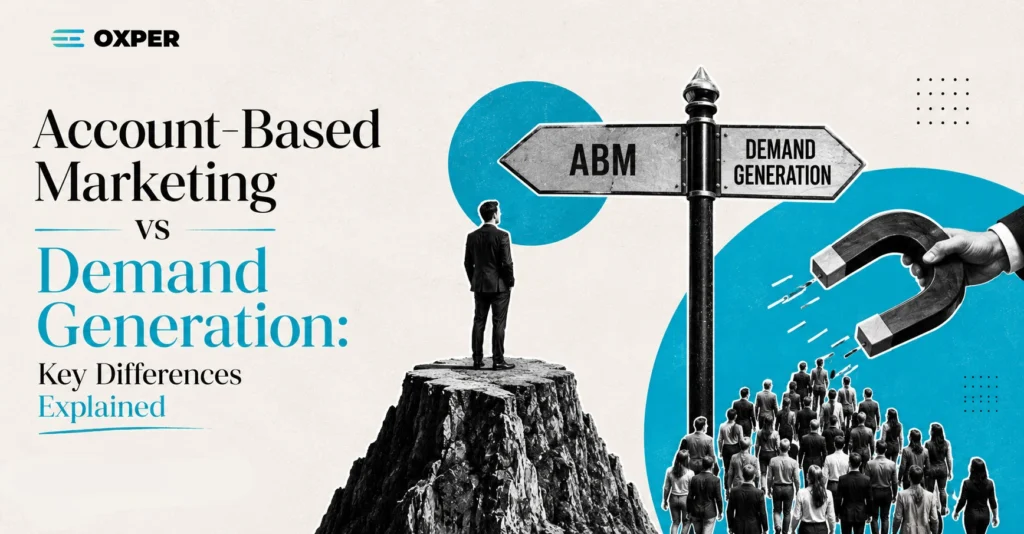
Right now, a business marketing expert may be in the meeting regarding budgeting where he or she has to choose between investing funds in account-based marketing or in demand generation activities.
Many marketing guides will testify to this being a routine strategic dilemma in the B2B industry. At the same time, it is also the wrong question. You wouldn’t ask if your car requires an engine or wheels. It is high time to explain why, but first let’s indicate that both of these methods have their specificities in terms of targeting logic, metrics, economics and flaws.
The Two Definitions, Without the Jargon
Account-based marketing (ABM)
Account-based marketing (ABM) originates with a named list. You specify and identify those companies — typically between 100 to 300 — that fit into your ideal customer profile and, accordingly, personalize your marketing and sales applications to engage their respective buying committees. It is ‘spear fishing’ because before engaging each fish you know what its name is.
Demand generation
Demand generation begins with the market. Through awareness building and educating the target audience, which is most often achieved with the help of the content, thought leadership, SEO, webinars, and paid media, the ultimate purpose is to be the brand of choice when people start to show buying predisposition. It’s ‘farming’ as opposed to ‘fishing’ because you need to cultivate the whole field and be ready to harvest once there are ripe crops available.
Account-Based Marketing vs Demand Generation: Side-by-Side
Here’s the comparison in one scannable view:
| Dimension | Account-Based Marketing | Demand Generation |
| Starting point | Named target account list | Total addressable market |
| Targeting logic | Fit-first: choose accounts, then engage | Reach-first: attract audience, then qualify |
| Personalisation | Deep — by account and committee role | Broad — by segment or persona |
| Primary metrics | Account engagement, pipeline from target list, deal velocity | Audience growth, MQLs, cost per opportunity |
| Sales involvement | Essential from day one | Typically enters after intent signals |
| Time to results | 1–2 quarters (matches enterprise cycles) | 3–6 months to compound, then accelerating |
| Cost profile | High per account, efficient per closed deal | Lower per touch, efficient at scale |
| Best fit | High ACV, definable market, complex committees | Broader markets, shorter cycles, category building |
| Failure mode | Bad account selection wastes everything | Volume without qualification floods sales with junk |
Read the last row twice. Each model fails in its own signature way, and knowing your likely failure mode is half of choosing well.
Where Each One Wins
Account-based marketing wins when the math favours precision.
In cases of costly contracts, if your likely consumers number a few hundred businesses, and if every deal is made by a six-member group, then spending broadly would be unreasonable. Almost all impressions are aimed at businesses that cannot bring you any cash. With ABM, you manage your budget with maximum effectiveness – that’s why an ABM marketing agency will always ask about deal size before anything else, and it should leave if the arithmetic does not add up.
Demand generation wins when the market needs building.
New categories, wider ICPs, mid-ticket products, and other situations when consumers do not know that they have a problem. Creating demand generation awareness which turns every subsequent process into something easier: warmer leads, better ad conversion, and reduced time for selling. Besides, it is incremental – content and SEO engines are working for years after the article is written.
And a hard truth for both sides. Account-Based Marketing and existing awareness do not go together well; cold accounts require much more effort to respond.
The Question Behind the Question
Please take note of what really influences the decision-making process: it is not trends, or a competitor’s activities, but three critical values.
Average contract value.
Below a certain ACV, personalization will not be cost-effective on an account basis. Above it, neither will the scattergun approach.
Addressable market size.
Two hundred potential clients? You can readily identify them — that’s the Account-Based Marketing market. Twenty thousand? You will need demand generation capabilities.
Buying committee complexity.
The involvement of many stakeholders in each transaction favors the orchestration of Account-Based Marketing; simple acquisitions favor mass marketing.
Use these three criteria for your firm’s operations and the outcome will usually become clear.
Why the Best B2B Programs Refuse to Choose
When two decades of watching these programs are distilled down into one simple statement it turns out that all the best B2B revenue engines are using both methods mixed together in a carefully thought-out sequence.
There is a term specially designed for this blend —Account-Based Marketing vs Demand Generation is no longer an either-or decision but an integrated growth model, often referred to as account-based demand generation, which is best represented by the flywheel movement.
Demand generation warms the field Account-Based Marketing harvests.
When demand generation warms up the market, account-based marketing captures the fruits of that. Your content, webinars, and web presence build up recognition with the audience, including your target accounts. Later when account-based marketing campaigns approach these target accounts, they come to an already familiar brand. This leads to significant increases in engagement rate, decreased cost per meeting.
ABM data sharpens demand gen.
The extensive account research which is obligatory for ABM — real pains, real objections, and real triggers — gives a lot of valuable content fuel to the demand generation engine. The questions, which Tier 1 committees ask, become articles attracting the next thousand targets.
Demand generation surfaces tomorrow’s target list.
Those companies which use demand generation without account-based marketing (or vice versa) end up with an incomplete engine in their hands.
How Oxper Runs Both Under One Roof
The integration is exactly why Oxper is designed as a 360° B2B marketing agency and not a specific solution in the market.
Our account-based marketing team works with precision: account selection and scoring, committee mapping, tiered personalisation, and targeted sales initiatives. Meanwhile, our B2B demand generation team is responsible for solid marketing foundations: SEO and AI search, content marketing, thought leadership on LinkedIn and webinars. Marketing automation combines the first two practices together – allowing scoring of the engagement, shifting warm accounts to the target lists and providing signals for sales in real time.
When one team takes all responsibility for these processes along with the landing pages, creative and analytics involved, the flywheel starts working. Don’t be confused by vendor gaps or agencies claims, all statuses of the pipeline are at one place for access and understanding.
Unlike standalone Lead generation services, Oxper combines B2B marketing services, Account-Based Marketing, B2B demand generation, SEO, automation, and analytics into one integrated growth system.
Stop Choosing, Start Sequencing
In the battle of Account-Based Marketing vs Demand Generation, there is no clear-cut answer. What you need is a certain order of operations. Your ACV, market size, and committee complexity will indicate which approach wins.
Use demand generation to create the buzz that makes your accounts accessible. Utilize account-based marketing to land the most desirable targets in your aim and be sure you correlate everything with automation and data, thus enabling one scheme to support the other.
Alternatively, you can reach out to us. Schedule an appointment with Oxper, and we will process your information according to the three questions provided, identify the approach you must stick to, and help you develop a strategy for the upcoming three months.