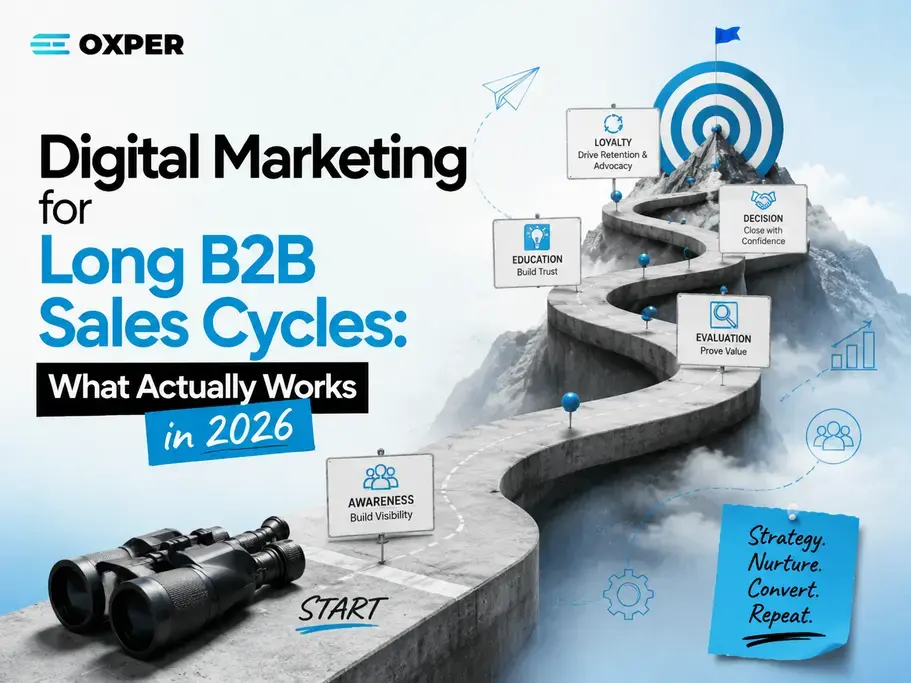
B2B sales cycles aren’t getting any shorter, honestly. They’re getting a lot tougher to manage, like, day to day.
New research from Gartner and Dentsu B2B shows that the average enterprise B2B sales cycle hit 379 days in 2024, up 16% since 2021, and yes buy committees are getting bigger across most enterprise segments. On top of that procurement approvals are taking more time too, so the full journey will likely stretch even further through 2026 across most categories. And that’s exactly where traditional campaigns start to miss… halfway through the funnel.
Single ads tend to lose their momentum, leads kinda disappear into those “dark periods,” and attribution models can’t properly connect a 12 month buyer journey.
So the brands that are actually doing well right now are the ones that blend account influence, steady visibility, and multi stage nurturing. The point is to build long runway sales cycles with digital marketing services, not just those quick lead spikes that look good in the short term.
Why Standard Digital Marketing Fails Long B2B Sales Cycles
Most marketing programs have been structured around short buying journeys.
That’s the real challenge.
When a B2B negotiation can take from 6 to 18 months to finalize, then the typical “generate leads immediately” approach quietly starts failing. The figures may still look good on paper, but over time, the quality of the sales pipeline deteriorates.
The first failure often originates in the very act of measuring. Many agencies still use lead volume or CPL to assess campaigns with long cycles. But enterprise buying differs from ecommerce. These days, a single form submission rarely denotes buying intent. Per Forrester’s 2026 B2B Buying Study, enterprise purchases go through several stages of internal validation even before the vendor is contacted. What is key is account engagement and buying influence, not isolated lead counts. When KPIs are always on lead quantity, very good long buying cycle marketing programs are frequently terminated before their productive phase.
The second problem is buying group blindness. According to Gartner’s 2026 B2B Buying Committee research, the average enterprise purchase usually involves 68 stakeholders from finance procurement operations, IT, and leadership. Though, several campaigns still only focus on the initial inquiry contact. So, essential decision-makers totally miss your messaging. And, when the deal is presented to the committee, your brand simply becomes unknown to half of them.
Next is attribution collapse.
Here is what usually happens: a potential client finds out about your brand through a LinkedIn insight post in January, joins a webinar in March, looks up two comparison blogs in June, and finally asks for a demo the next February. In a 30-day attribution window, nearly all marketing efforts that actually led to the deal get disregarded. Gartner has warned several times that last-click attribution Much underestimates long-cycle pipeline influence, In particular in the enterprise B2B context.
Here’s the essence of a well-structured digital marketing strategy over a 618 month B2B cycle.
The 5-Stage Digital Marketing Framework for Long Sales Cycles
Stage 1 — Awareness: Content Marketing That Reaches the Dark Funnel
Most B2B buying journeys start way earlier than your CRM even gets a whiff of the account.
Per Gartner’s B2B Buyer Enablement work, roughly 70% of enterprise buying activity takes place in private channels before any vendor contact shows up—things like internal Slack threads, peer recommendations, analyst writeups, LinkedIn back and forth, and independent research. So, in practice, your brand footprint needs to show up months earlier than most teams think they can get away with.
That’s also why content marketing for B2B feels almost foundational in the first place. SEO-led long form pages, executive LinkedIn thought leadership, webinars, plus industry focused insights build real familiarity before the buying committee even starts narrowing down the shortlist.
And one practical angle tends to work especially well: put out one deep dive insight piece each month, aimed at a particular stakeholder pain point—CFO worries, procurement friction, operational inefficiencies, or technical implementation risk.
Most enterprise buyers already have preferred vendors in mind before the first inquiry form is submitted.
Explore how Oxper helps B2B brands stay visible throughout the entire buying journey.
Stage 2 — Account-Based Marketing (ABM): Target Accounts, Not Individual Leads
Traditional lead generation kind of locks in on individuals, like you pick a person, then go from there.
But account-based marketing (ABM) flips that whole thing completely, kinda backwards.
Rather than waiting around for random inbound leads, ABM begins by choosing high-value accounts first — then it works on coordinated messaging across the full group of stakeholders who actually end up shaping the purchase decision.
Demandbase and 6sense 2026 benchmark reports say it pretty directly. Intent-driven ABM campaigns aimed at accounts that are actively researching can convert at about 35–40% , while broad untargeted outreach campaigns land closer to roughly 10%
So yes, the difference is significant, even when the target is similar.
Still, real ABM isn’t just LinkedIn ads aimed at job titles, or a sprinkle of targeting here and there.
It needs account prioritization, plus stakeholder mapping, and messaging that stays coordinated across channels.
Then there’s CRM alignment and the sales marketing synchronization… and none of that is optional.
The companies seeing real outcomes in 2026 are treating ABM like a revenue strategy, not like a simple ad tactic.
Stage 3 — Lead Nurturing: Staying Visible Through the Dark Periods
One major misunderstanding in long-cycle marketing is thinking that no response means the deal is off.
Actually, that’s rarely the case.
Usually, enterprise deals go silent for a few weeks or even months while internal approvals, budgeting, and procurement are done. Most companies that quit communicating at this point end up losing ground to the ones that keep showing up regularly.
That’s the reason lead nurturing is a huge part of marketing when you have a long buying cycle.
In fact, enterprise nurture benchmarks by Forrester and HubSpot show that automated nurture programs lead to a 47% increase in average deal size compared to non-nurtured ones. Yet, what separates nurturing in 2026 is the way it is done. Static monthly email blasts don’t produce results anymore. Behavior-triggered workflows like content engagement, webinar activity, page visits, or stakeholder interaction outperform calendar-based automation all the time.
You don’t want to be busy selling all the time. You want to be in the buyer’s mind when the buyer changes internally.
Long sales cycles don’t fail because buyers forget their problem. They failed because another brand stayed visible longer.
See how Oxper builds CRM-integrated nurture systems for enterprise pipelines.
Stage 4 — Marketing Automation: Scaling Personalization Across a Multi-Month Funnel
Many businesses still associate marketing automation with just scheduling email campaigns.
Such a rationale is outdated.
In 2026, the word “automation” will be mostly linked to predictive intent analysis, AI-powered lead scoring, stakeholder engagement tracking, and CRM-synced buying stage workflows. Contemporary platforms can even detect behavioral resemblances between active accounts and closed customers often before a lead submits a form.
That turns enterprise demand generation on its head.
Where before buying signs had to be manually followed, automation solutions today highlight those accounts whose research behavior patterns indicate a higher chance of conversion. As a result, salespeople can give earlier attention to targeted accounts and also have more precise personalization in their outreach, raising the accuracy of personalization.
For B2B companies with 618 month sales cycles, automation is not only about making efficacious operations; it mainly focuses on timing the relevance accurately.
Discover how Oxper uses CRM-aligned automation and demand generation workflows through its B2B marketing services setup.
Stage 5 — Performance Measurement: The Metrics That Actually Reflect Long-Cycle ROI
Poor metrics are silently killing great marketing campaigns.
If leadership only focuses on the number of form fills as a metric, then results of short-term campaigns will seem attractive Mainly when compared with long-cycle influence strategies at least at first. The reality is Though that enterprise revenue does not simply respond to these short attribution windows any more.
Measurement needs to be shifted toward account engagement score, buying group coverage, MQL-to-SQL progression, multi-touch attribution, and pipeline velocity.
Based on the benchmarks for Revenue Operations maturity by Gartner, companies that are fully embracing revenue operations achieve approximately 30% faster conversion of sales cycles and 20% better close rates compared to marketing-sales systems that are disjointed.
Though, stakeholder penetration has become a very critical metric in 2026.
Put simply, the question is – how many individuals in your target account have actually engaged with your content?
It is that figure, in fact, which frequently indicates the direction of a deal – much more than just the number of leads alone.
2026 Trends Reshaping Long B2B Sales Cycle Marketing
Intent Data Activation Is Becoming Non-Negotiable
Tools such as 6sense, Demandbase, and Leadfeeder enable marketers to pinpoint which accounts are actively looking for solutions before they even make direct contact. This definitely turns the outbound strategy on its head. Rather than speculating who could be interested, squads get to put first accounts that are already showing signs of buying intention. Per Demandbase 2026 ABM benchmarks, intent-driven campaigns are yielding results almost 3x higher than those done with blind outreach with conversion efficiency on a consistent basis.
Buying Committees Keep Expanding
Gartner’s newest enterprise buying research says that the typical enterprise buying group now has about 6–8 stakeholders, so yeah, the whole thing is not as simple as it used to be. Because of that, single-threaded marketing, where every bit of messaging is aimed only at one “champion” , becomes really risky fast. In other words, modern B2B content strategies now need messaging that fits each stakeholder, mapped across operational, financial and technical priorities all at the same time, more or less.
AI-Driven Lead Scoring Is Replacing Static Qualification Models
Traditional scoring systems largely depended on form fills and demographic filters. AI-driven scoring models However analyze behavioral patterns, speed of account engagement, depth of research, and historical conversion resemblance. This way, sales teams can spot high-intent accounts much earlier and minimize the amount of outreach that doesn’t produce results.
How Oxper Helps B2B Brands Navigate Long Sales Cycles
Most companies in the field are still just focused on increasing lead numbers eventually.
On the contrary, Oxper has a different way of creating enterprise demand.
Putting together effective B2B marketing machinery that can handle the buying journey over a long time is the main point – this can mean account-based marketing, lead nurturing integrated with CRM, multi-touch demand generation, and pipeline visibility during long cycles.
Rather than run separated campaigns, Oxper creates integrated growth ecosystems in which SEO ABM automation, LinkedIn thought leadership and sales enablement collaborate throughout a 6-18 month period.
That really comes into play for big companies, where decisions are usually made by several people over a period of time.
So if your sales process lasts for more than 6 months, let’s devise a marketing plan that keeps up with it, in fact.