A few years ago, B2B search strategy was easier to explain.
You created useful pages, earned rankings, improved domain authority, and waited for the right buyer to find you on Google.
That still matters. But the buyer journey around search has changed.
A procurement head may Google a problem in the morning, ask ChatGPT for vendors after lunch, use an AI-generated search summary to compare approaches, and finally visit two or three company websites before speaking with sales.
That change has brought up a question of SEO, GEO, and AEO.
Should B2B firms keep pouring money into SEO? Do we need to change the focus to Generative Engine Optimization? Is Answer Engine Optimization necessary now? Or do marketers create new terms for something they should have been doing earlier anyway?
The matter is not so serious as it is announced in the headlines.
B2B companies probably need all the three trends mentioned. The only thing that is changing is the order of their importance.
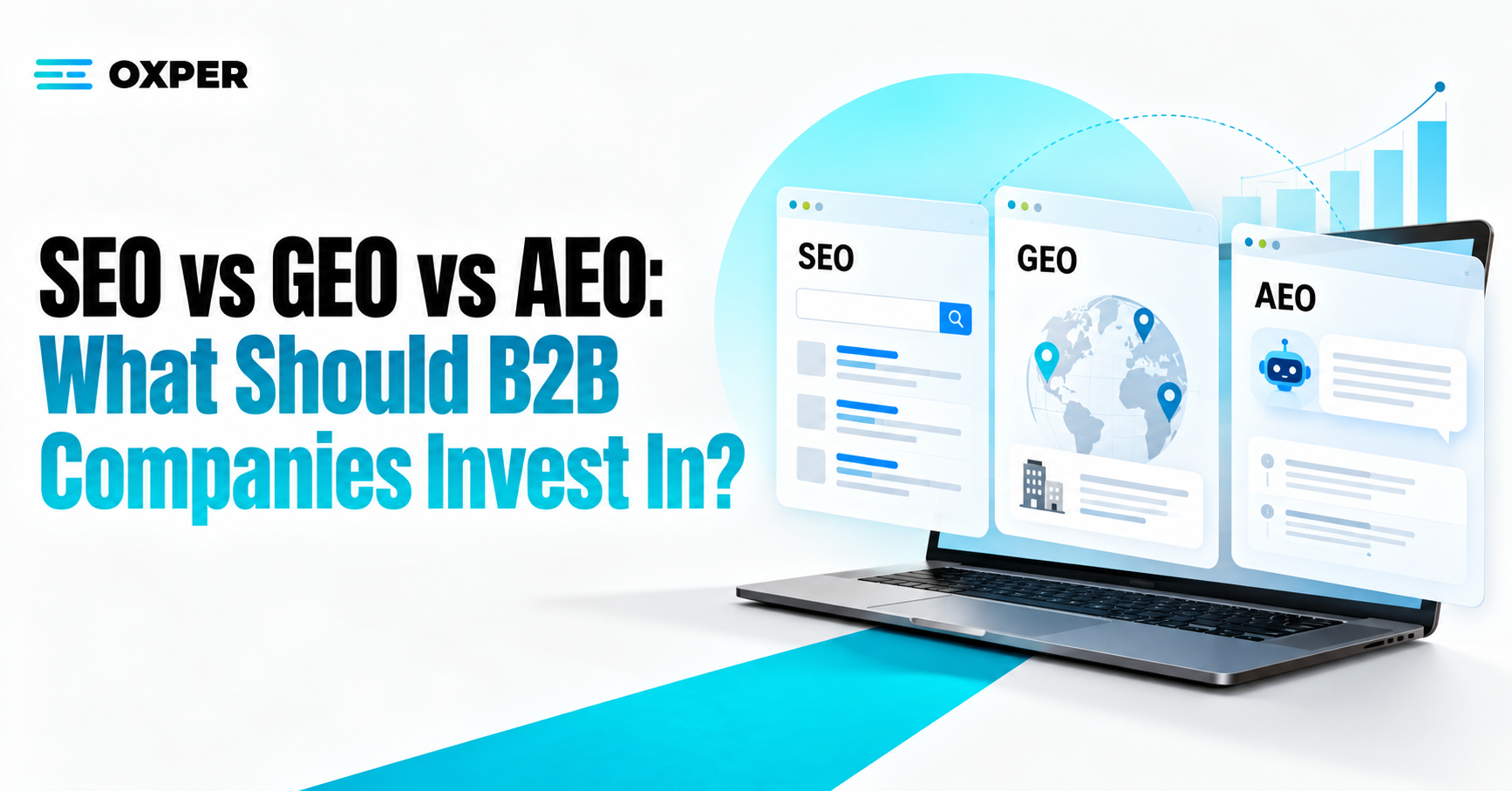
SEO vs GEO vs AEO: What Are We Actually Talking About?
Before allocating budgets, it helps to remove some of the jargon.
SEO is still about making your website easier to discover through search engines. That includes technical SEO, content quality, keyword intent, site architecture, backlinks, internal linking and user experience.
Generative Engine Optimization is concerned with something different: whether AI-powered search systems can understand your expertise well enough to reference, summarise or cite it in generated responses.
Answer Engine Optimization sits somewhere in between. It focuses on making information easy to extract when someone asks a specific question.
For example, imagine a CIO researching marketing automation partners.
A traditional Google search might be:
“B2B marketing automation agency India”
A conversational search might look more like:
“Which type of agency should a B2B SaaS company hire to automate lead nurturing across CRM, email and paid campaigns?”
Same buyer. Same commercial problem. Very different search behaviour.
That is why the SEO vs GEO vs AEO discussion is not really about choosing one discipline over another. It is about understanding how discovery is changing.
SEO Has Not Suddenly Become Irrelevant
There is a habit in digital marketing of declaring an existing channel dead whenever something new appears.
SEO has survived quite a few funerals already.
Voice search was supposed to change everything. Social search was going to replace Google. Zero-click results were going to destroy organic traffic.
None of those developments made SEO disappear.
AI search probably will not either.
All B2B businesses recognize the importance of using SEO as an integral component of their success as they come to the conclusion of determining the best form of marketing for themselves due to the fact that potential clientele generally checks the company’s website before making a commitment.
It can be said that even though AI may introduce companies to possible buyers or a search engine result may create brand awareness a company’s website remains the main point of entry for people who are making serious B2B purchases.
If the potential client visits the website, he/she may find out that the supplier has the necessary level of industry expertise and offers services needed by clients and finds the evidence that the company is worth trust.
It should be noted that a weak website will not be transformed into a strong tool just due to applying a GEO approach to it.
This is the main point of comparison when one considers GEO and SEO.
If your content is generic, your website does not have proper technical optimization and the information you provide is useless for potential clients, the best advice would be to invest your money in
Where GEO Starts to Matter
Generative Engine Optimization becomes more interesting when the buyer is no longer looking for a list of links.
They are asking for a recommendation, comparison or explanation.
That changes the job of content.
Traditional SEO often focuses on whether a page ranks for a target query.
GEO asks another question:
Would an AI system consider this content useful enough to draw from?
That is a tougher standard.
A 1,200-word article written mainly to include a keyword twenty times may technically rank. It may not be particularly useful to a generative engine.
Content that performs well in AI-driven discovery tends to need more substance.
Clear explanations help. So do original observations, useful comparisons, expert commentary, credible data and pages that answer a topic properly rather than circling around it.
For B2B marketers, this is actually healthy.
Generative Engine Optimization pushes content teams away from publishing for volume and towards publishing material worth referencing.
AEO Is Less Exciting, but Often Easier to Implement
Answer Engine Optimization does not always require an entirely new content strategy.
Sometimes it requires better editing.
Take a common B2B question:
“What is account-based marketing?”
A lot of websites would spend three paragraphs warming up before answering it.
That is bad for impatient readers and not particularly useful for answer engines.
A stronger approach is to give the answer early, then add nuance.
The same principle stands for pricing-related inquiries, implementation-related inquiries, comparison-related inquiries, inquiries concerned with definitions, and frequently asked questions.
Engine optimization of answers is therefore primarily dependent on the arrangement of the information.
Titles need to correspond to actual inquiries.
Definitions should be straightforward.
Main information should not be hidden under needless introductions.
Tables, FAQ sections, and other comparative sections can assist if they simplify the information.
It is now easier to draw a line between engine optimization of answers and engine optimization of geography. The former refers to the facilitation of the retrieval of the answer, while the latter is much broader and implies receiving marketing communications on behalf of the customer.
They overlap, but they are not exactly the same thing.
Where AI Search Engine Optimization Fits In
You will also hear another term increasingly often: AI Search Engine Optimization.
It is useful, but only if you treat it as an umbrella rather than another silo.
AI Search Engine Optimization brings together many things marketers already understand: strong SEO foundations, structured content, credible expertise, clear brand positioning and better coverage of conversational search queries.
The biggest shift is probably in how keyword research is interpreted.
Traditional keyword research may tell you that “B2B lead generation agency” has commercial demand.
AI-focused research should go further.
What would someone ask before searching for that phrase?
They may ask:
“How do I choose a B2B lead generation agency?”
“Should I outsource demand generation or build an internal team?”
“What should a B2B lead generation agency actually be responsible for?”
Those questions reveal the thinking that happens before a buyer reaches a service page.
That is where AI Search Engine Optimization becomes strategically valuable.
So Where Should B2B Companies Spend Their Money?
There is no sensible universal split such as 50% SEO, 30% GEO and 20% AEO.
The appropriate investment depends on where you are starting from.
If your website ranks poorly for any business keyword, then start with correcting your search engine optimization (SEO).
If you already enjoy a good organic traffic flow and the only issue is the ambiguities of your content, then address your Answer Engine Optimization (AEO).
If the clients from your niche are increasingly employing AI technology to short list suppliers or clarify solutions, start working on the Generative Engine Optimization (GEO).
In the case of programs already in place, these actions need to be coordinated.
A developed service page can be ranked organically.
At the same time, the particular webpage can provide a short explanation that would give support to AEO.
Additionally, relevant articles, opinions and structured content have a potential to add to the usefulness of the page from AI perspective.
That is why the GEO vs SEO questions might have a confusing context. They are not strictly opposite investments.
What B2B Teams Should Do Next
Instead of creating three separate content programmes, start with the buyer journey.
List the commercial questions buyers ask before contacting sales.
Then map the search environments where those questions appear.
Some will belong to traditional search. Others will show up inside AI tools, answer engines, forums or social platforms.
From there, audit the content.
Are your answers specific?
Do you provide genuine expertise or repeat information that already exists everywhere else?
Can someone understand your position quickly?
Is the website technically strong?
Can important pages be found and connected easily?
That exercise will tell you far more than chasing the newest acronym.
How Oxper Can Help
For a B2B business, search visibility should ultimately lead somewhere.
Traffic without commercial intent is not particularly valuable. Neither are AI mentions that never translate into consideration.
Oxper approaches SEO, GEO, AEO and AIO as parts of a wider growth system.
That means search strategy can connect with Account Based Marketing, lead generation, paid campaigns, website experience, UI/UX, social media and marketing automation rather than operating as an isolated content function.
For example, an SEO article may attract a research-stage buyer.
A well-built internal journey can move that person towards a service page.
Marketing automation can nurture the account.
ABM and paid media can continue the conversation across other channels.
That is where search becomes commercially useful.
Invest in the Search Journey, Not the Acronym
The debate around SEO vs GEO vs AEO sounds more complicated than it needs to be.
SEO is still the base layer.
Answer Engine Optimization acts to improve the chances of your content effectively treating actual questions.
Generative Engine Optimization enhances the probability for your know-how to come into play in cases when AI systems create solutions for their prospective clients.
It would be erroneous to view it as three disconnected trends and form three independent strategies.
B2B customers do not think in acronyms. They navigate through the web and AI tools in search of better solutions.
Your strategy should follow them.
If your business is trying to work out where SEO, GEO, AEO and AI Search Engine Optimization fit into its growth plan, Oxper can help build a search strategy around buyer intent, visibility and qualified demand rather than rankings alone.