A manufacturing company does not usually wake up one morning and decide it needs more Instagram posts.
The pressure tends to come from somewhere else.
It appears that inquiries are down. We need a new factory to do some business. The sales crew is depended upon existing clients and associates. Dealers are supplying erratic leads. And competitors who are not as successful are present in all the places where people look for products.
That is when it would make sense to get an industrial marketing agency involved. The problem is with choosing the right agency.
Most agencies can boast a sophisticated website, a presentation showing successful campaigns, and a long list of services that comprise SEO, paid ads, social networking, and content generation. However, only a few agencies understand the whole process of the customers’ journey from discovering the product to placing the order with an engineer.
Manufacturers have to take this difference into account.
Why Manufacturing Marketing Needs a Different Kind of Agency
Selling an industrial product is not the same as selling shoes, subscriptions or restaurant bookings.
Before contemplating costs, a buyer will want to know specifications. Engineering may play a role in the preferred supplier list. Operations may have other issues to contend with. Procurement comes into play later. Management may give its nod for the purchase. A supplier of products may be located between the manufacturer and the customer.
It is this very complexity that makes Manufacturing Marketing different.
A marketing plan that results in thousands of downloads means nothing if the persons downloading happen to be students, job seekers, or companies that cannot buy the product anyway.
A website that is attractive and pretty without any technical information may do even more harm than good.
A well-qualified Industrial Marketing Agency knows that marketing should not just be about “getting more engagements.” Proper marketing should allow suitable industrial buyers to find out about the company and its services.
Start With One Question: Do They Understand How You Sell?
Before asking about SEO packages or media budgets, explain how your business actually wins customers.
Do orders come directly from manufacturers?
Do distributors generate most business?
Are you trying to reach OEMs, EPC contractors, plant heads, consultants or procurement teams?
Does a typical opportunity close in four weeks or twelve months?
These questions expose the difference between a general B2B Marketing Agency and one capable of handling industrial accounts.
An agency does not need twenty years of experience selling your exact machine. It does, however, need to understand long decision cycles, multiple stakeholders and technical evaluation.
If its first recommendation is “post more frequently on social media” before anyone has asked about customers, margins, territories or your sales process, be careful.
Good Industrial Marketing starts with the commercial reality, not the content calendar.
Check Whether They Can Translate Technical Expertise
Manufacturers often have plenty to say. The problem is that much of it lives inside product catalogues, sales presentations, engineers’ heads and specification sheets.
The role of an agency is to add value to technical information.
For example, if a company manufactures industrial pumps, an engineer would prioritize material compatibility and working conditions, while a plant manager might be interested in minimizing downtime. Likewise, the procurement department may be focused on the total cost of the product and the supplier’s reliability.
Despite being different, all three groups can have the same effect on the purchase decision.
Successful Manufacturing Marketing matches product capabilities with the problems different stakeholders are trying to solve.
Ask agencies how they would convert one technical product into a service web page, a search campaign, a case study, or a LinkedIn post. The answer to this question is much more important than a presentation of their work experience.
Look Beyond Traffic and Ask About Lead Quality
This is where agency conversations often become uncomfortable.
Everyone likes talking about traffic growth.
Fewer agencies want to define what counts as a commercially useful lead.
Manufacturers should.
Ask what happens after someone submits a form.
How will enquiries be qualified? Can campaigns distinguish between an end user, distributor, supplier and job seeker? How are high-value accounts treated differently? Can leads be routed by product, geography or dealer territory?
Oxper’s own work around dealer-led manufacturing highlights this issue: manufacturers need more than enquiry volume; lead ownership, routing, dealer follow-up and visibility after handoff also matter.
That is especially important when evaluating a Marketing Agency for Manufacturing Companies.
Thirty relevant opportunities can be worth far more than 300 low-intent contacts.
The agency should understand that before the campaign begins, not after sales complains about lead quality.
Evaluate Their SEO Thinking Carefully
Industrial SEO can go wrong surprisingly quickly.
An agency finds a high-volume keyword, writes ten generic blogs around it and reports an increase in impressions.
Technically, something happened.
Commercially, perhaps nothing did.
Search Engine Optimization for manufacturers needs to reflect how industrial buyers research.
Some searches will be product-led. Others will involve applications, specifications, troubleshooting, alternatives, suppliers or manufacturing processes.
The agency should be able to separate educational search demand from buying intent and build different content for each.
Ask them which pages they would optimise first and why.
If every answer involves “publishing more blogs,” keep looking.
A mature Industrial Marketing strategy usually needs stronger product and application pages, technical content, internal linking, comparison content and conversion paths alongside articles.
Find Out Whether They Understand Account-Based Marketing
Not every manufacturer needs thousands of leads.
Sometimes the addressable market consists of 200 companies that genuinely matter.
That changes the maths.
If a manufacturer sells capital equipment, specialty materials or enterprise-scale industrial solutions, broad lead generation may create enormous waste.
A good B2B marketing agency would know just when to begin making the transition from a volume-based demand generation approach to an account-based marketing approach.
That could involve selecting target companies, mapping key stakeholders, developing industry-specific messaging, and coordinated LinkedIn, paid campaigns, content, and sales outreach to those accounts.
Oxper positions its B2B demand generation offering around personalised buyer journeys, ABM, SEO, lead generation, and marketing automation rather than treating each channel separately.
For manufacturers with high deal values, connected approaches certainly have a better basis than pursuing leads solely on cost.
Ask How Channels Will Work Together
One warning sign is an agency that presents every service as a separate box.
SEO sits here.
LinkedIn sits there.
Paid media belongs to another team.
Marketing automation gets discussed six months later.
Buyers do not experience marketing that way.
A person may find a particular manufacturer through a Google search, later spot the same company on LinkedIn, go through a case study, visit the application page, and submit a request for quote weeks later.
One channel triggers actions within other channels.
So when figuring out how to choose an industrial marketing agency, ask the agency to show the customer journey instead of service offerings.
What you need is to see all the customer journey steps from the very first touch to the closing of the sale.
Such a conversation would show whether the agency thinks in campaigns or in commercial systems.
Ask to See the Reporting Before You Sign
Do this before the contract, not three months afterwards.
A report dominated by followers, reach and impressions may look busy while telling management very little.
Industrial businesses should eventually be able to connect marketing with meaningful outcomes: qualified enquiries, target-account engagement, RFQs, quotations, opportunities and pipeline.
Not every deal can be attributed neatly to one campaign. Manufacturing sales rarely work that cleanly.
Still, an agency should demonstrate how it intends to move reporting closer to revenue.
Ask one simple question:
“What would make you tell us this campaign is failing?”
A serious agency will have an answer.
Red Flags When Choosing an Industrial Marketing Partner
Exercise caution if an agency says that they can assure page one rankings without analyzing the website or states that it can give a fixed number of leads without researching the market or talks endlessly about creativity with no reference to sales.
A red flag is oversimplification.
Industrial customers do not like the simplification of the complex product to a catchy slogan of three words. In fact, being precise can provide the buyer with confidence.
A competent Manufacturing Marketing Agency should know which things to simplify and which to preserve.
This is not something you can pretend to know.
How Oxper Approaches Manufacturing Growth
Oxper’s B2B capabilities bring together SEO, lead generation, demand generation, Account Based Marketing, performance marketing, social, website development and marketing automation.
What’s important for manufacturers is that the features being developed can already be connected with the sales process as opposed to being treated as separate marketing efforts.
Oxper also has experience across various industries having processes linked to manufacturing, including heavy machinery, industrial machinery, chemical and packaging industries.
Thus, it becomes possible to begin talking about target industries, dealer networks, priority accounts and qualified opportunities before knowing what channels to invest into.
Choose for Commercial Understanding, Not Agency Size
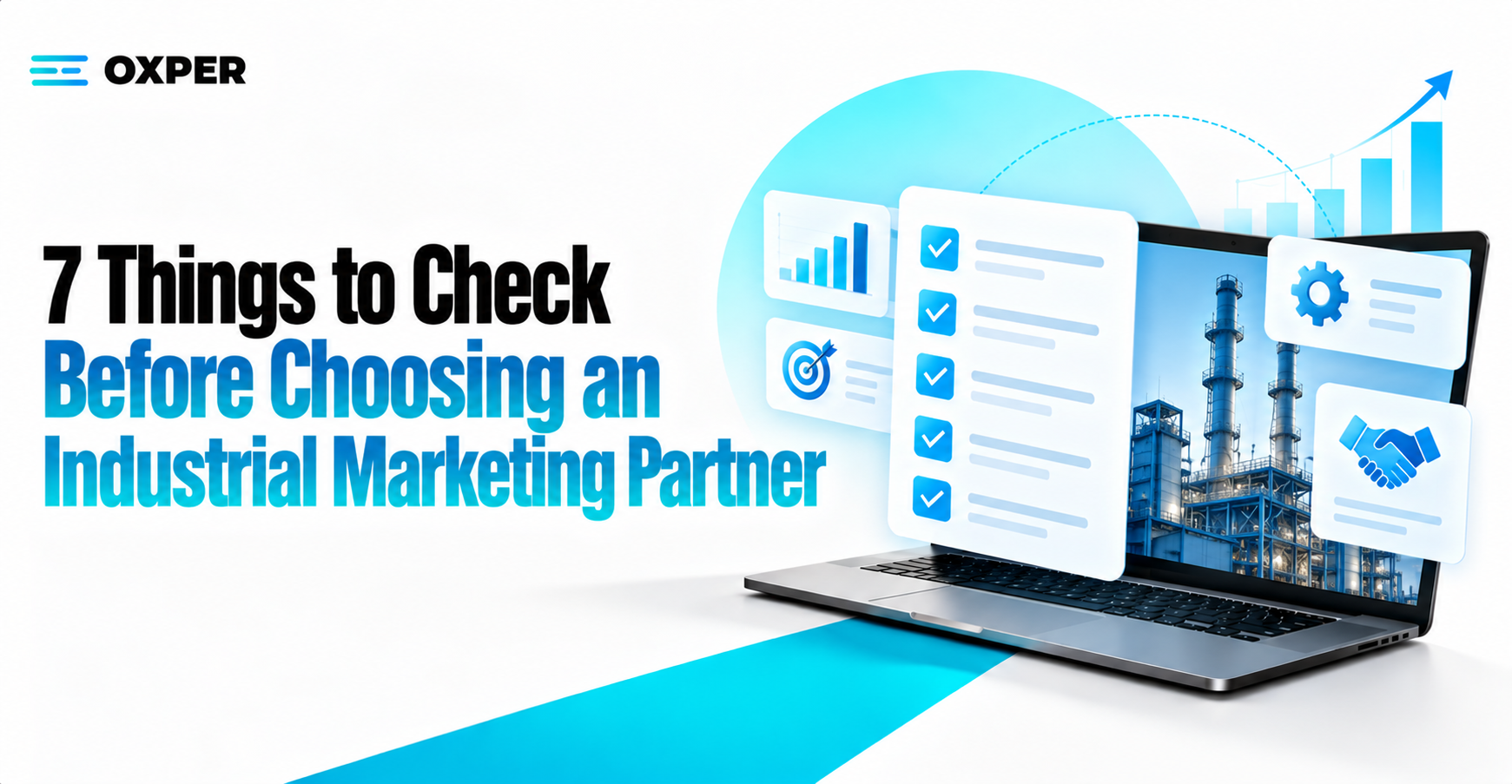
Knowing How to Choose an Industrial Marketing Agency becomes easier once you stop comparing agencies purely by service lists.
Most will offer similar channels.
The significant defining distinctions are clearly more profound.
Is it clear to them what is the decision-making process of industrial purchasers? Are they capable of working with technical information while avoiding using jargon or meaningless promotion? Do they focus on potential leads rather than simple metrics? Are they able to connect marketing activities with sales?
The winning Industrial Marketing Agency will actually act similarly to your internal team.
If your manufacturing company wants marketing that supports pipeline rather than simply producing activity, Oxper can help build a connected B2B growth strategy around your products, markets, target accounts and sales process.