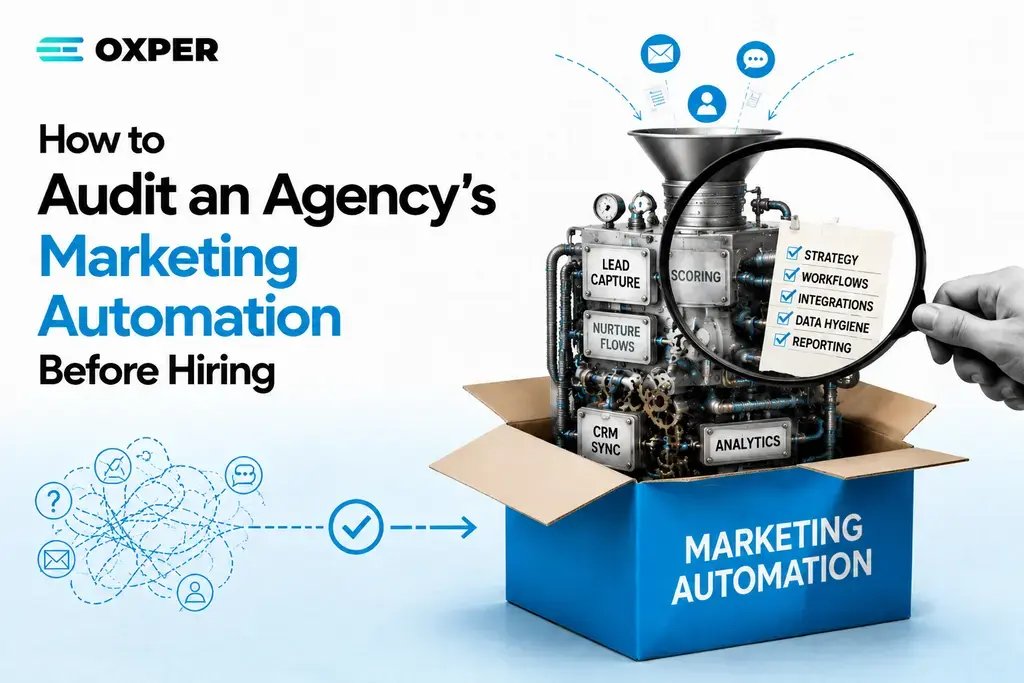
The majority of businesses fall into the same trap when they choose a digital marketing agency. They look at portfolios, pricing, and ads but they forget to check what kind of marketing automation the agency has.
In fact, this is the main source of costly mistakes.
Incorrect agency hiring can result in broken CRM workflows, disconnected reporting, inefficient lead nurturing, and a sales pipeline that leaks opportunities not only once but every single week. You may still get leads, but then it will become quite a mess to convert and track them.
This list will help you discover the areas you need to evaluate before you commit to any agreements.
Why Marketing Automation Audit Should Come Before Agency Hiring
Here’s the thing— a lot of agencies are good at showing reports. Far fewer are actually good at building systems that scale, like for real.
Many agencies still lean on generic tools and kinda disconnected workflows that don’t really match your business model. Their dashboards can look very polished, but in the background the automation layer is stitched together with shortcuts. It turns into a serious problem once lead volume grows, or once multiple teams start using the same CRM, and suddenly everyone’s moving differently.
Another common issue? Lead nurturing starts to fall apart at scale. A business might begin with manual follow ups and spreadsheet tracking, but that approach doesn’t hold up for long. Without proper automation logic, leads get ignored, duplicated, or handed to sales too late. And yeah, that directly messes with revenue.
Then there’s the sales and marketing disconnect. When CRM automation is weak, silos show up, marketing tracks one version of the numbers while sales works with another. Pretty fast, nobody trusts the data. Campaign reporting turns into guesswork, instead of actual decision-making.
This is why smart businesses now treat automation capabilities as a core part of their agency evaluation criteria. If an agency doesn’t have strong automation strategy consulting expertise, scaling becomes hard, even if their ads look great.
Now let’s kinda break down the actual audit process.
The 6-Point Marketing Automation Audit Checklist
1. Evaluate Their MarTech Stack Integration Depth
Request the agency to explain their entire technology stack. It’s important to check if they utilize top-tier platforms like HubSpot, Salesforce Marketo, ActiveCampaign or if they mostly rely on standalone no-code solutions.
A well-integrated MarTech stack should enable seamless CRM syncing, campaign attribution, analytics tracking, lead scoring, and reporting without the need for frequent manual intervention.
Directly ask this:
“How do your systems connect with our existing CRM and reporting setup?”
2. Assess Their Lead Nurturing and CRM Automation Workflows
Don’t just get screenshots – request an actual workflow demonstration.
A competent marketing agency can easily demonstrate how their lead nurturing and CRM automation sequences operate through the different stages of the buyer’s journey. Time-driven email is no longer the hallmark of good automation. It is all about reacting to user’s actions, intent signals, lifecycle stages, and engagement patterns.
And, it is good to find out if they have lead scoring models and use conditional automation logic.
Pose the question like this:
“Would you be able to present us with a live multi-stage nurturing workflow example which you have implemented for a B2B client?”
Before You Hire Any Agency
Most agencies pitch campaigns. Very few audit your automation gaps first.
If your CRM, reporting, or lead workflows already feel disconnected, fixing that before scaling ads can save months of wasted budget.
Explore Oxper’s automation-focused growth services
3. Review Their Automation Strategy Consulting Process
This component honestly has greater significance than what most businesses realize. A marketing automation agency that offers no written planning phase is most likely to be working on a whim. Good agencies do not simply leap, they start with process mapping, lifecycle analysis, audience segmentation, CRM review, and automation architecture part before they even get to the execution stage.
This is the kind of situation where real automation strategy consulting can assist you. You need the strategy first, not workflows randomly appearing.
Just put it like this, straight up:
“Before the actual implementation starts, what do you do as your automation planning process?”
4. Check Performance Measurement and Reporting Standards
A pretty weak reporting structure can quietly eat away at ROI visibility, slowly like it’s nothing. The agency ought to monitor metrics that genuinely steer revenue, like pipeline velocity, the MQL to SQL conversion flow, how fast deals move through the sales cycle, lifecycle engagement, attribution precision, and retention signals. If the reporting only lingers on impressions or clicks, well that’s a real red flag.
Strong measurement and reporting frameworks, those are what help leadership make quicker calls that feel more confident, instead of guessing.
Just ask it straight up, no softening it:
“How do you connect campaign reporting with actual pipeline and revenue impact?”
5. Verify Their B2B vs B2C Automation Experience
Business-to-business automation runs in a different vein, isn’t it? Prolonged sales cycles. More than one person involved in decision-making. Higher-value decisions.
An agency that has been solely working on B2C performance campaigns may find enterprise lead journeys quite challenging. When you are selecting a digital marketing agency, you should ask them for B2B examples like complex funnels, multi-channel attribution, and long nurture timelines.
You want a clear indication that they comprehend the dynamics of decision cycles in a slow-moving environment.
Ask this straightforwardly:
“Can you present examples of automation workflows that are geared towards a 6090 day B2B sales cycle?”
6. Audit Their Agency Evaluation Criteria and Onboarding Process
A reputable agency won’t instantly start executing your campaign.
At first, they will check things like the health of your CRM, the efficiency of your current workflows, the proper setup of your attribution, any reporting gaps, the quality of your database, and the level of your automation maturity. Usually, this initial audit unveils more about the agency than their proposal itself.
It is highly recommended to have a technical discovery phase as part of strong agency evaluation criteria before planning the execution.
You can ask them this question explicitly:
“May I know what your pre-onboarding audit entails before you start the automation setup?”
Red Flags to Watch Out for During the Agency Audit
They don’t provide any CRM integration demonstrations. Just saying, “we use CRMs” is insufficient.
You should request real-life examples of handling your very platform.
They only talk about vanity metrics in their reports.
Presenting the number of impressions and reach may appear very impressive, but they don’t give any hint to the revenue performance.
There’s no automation setup on record.
Execution of strategy tends to become inconsistent if strategy is only on calls but not in process documentation.
They mistake automation for email blasting.
Marketing automation at its best is about running segmentations, setting up triggers, scoring, creating workflows, working on attribution, and managing lifecycle, besides just sending out the scheduled newsletters.
How Oxper’s Automation-First Approach Solves This Problem
At Oxper, automation auditing happens before campaign execution starts, like yeah we check first. Instead of pushing every client into the same workflow structure , the team takes a look at what’s already there in the CRM setup, reporting visibility , lead routing logic, and the broader MarTech ecosystem overall. This is supposed to help spot where the real growth bottlenecks are hiding before scaling any campaigns.
It’s pretty handy for B2B companies too, especially when sales cycles are longer, there are multiple stakeholders, or reporting feels fragmented, honestly. After that, the automation workflows get designed around the client’s actual buying journey not generic templates.
Want us to audit your current setup before you hire anyone?