Picture a marketing director looking for a new demand generation partner.
A few years ago, the journey probably started with Google. They searched for an agency, opened several websites, read a few service pages and made a shortlist.
Now the identical user may launch their quest at a completely different point.
That person might request the answer from ChatGPT regarding which agency will cater better in the case of a complex B2B selling cycle. The user might compare and review the prompt that was generated by Google before also making any clicks. Later they search names of two agencies obtained in that process.
This is the transformation that AI search optimization has brought.
There is no need to say Google has died, but search is not limited to only ten blue links and a keyword box.
In B2B brands, it leads to a different meaning of being “visible in search.”
What Is AI Search Optimization?
AI Search Optimization is the practice of making a brand, website and its expertise easier for AI-powered search systems to understand, retrieve and potentially reference when answering a user’s question.
There is a familiar SEO foundation underneath it.
Your website must still be technically reachable. Pages must still convey meaning to search engines. Content still has to be valuable. Authority and relevance are still important factors.
Google itself continuously informs webmasters that traditional rules for search engine optimization are still applicable to its generative search experience.
What has changed, however, is the context where this information is delivered.
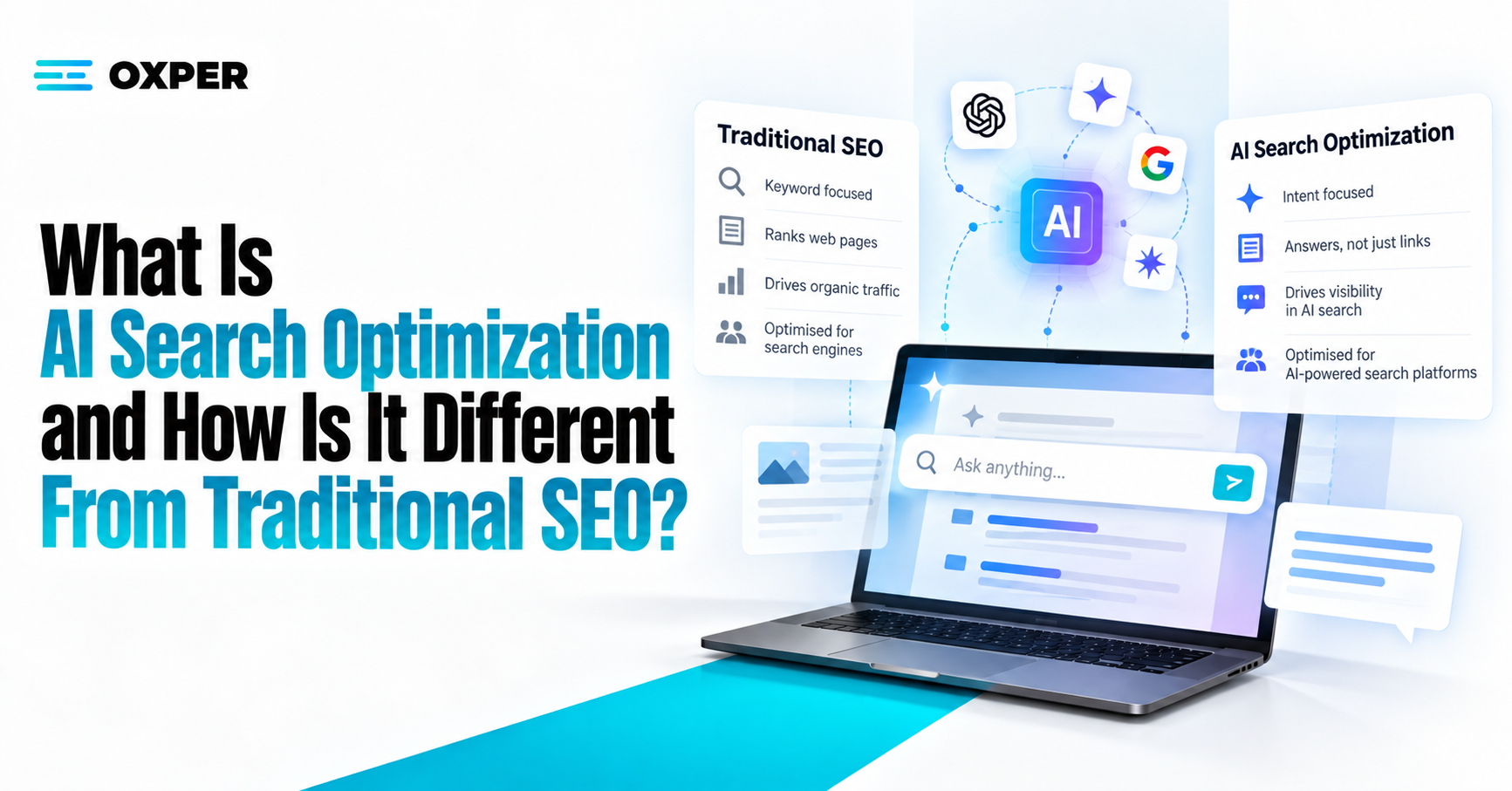
Traditional SEO is all about putting the page into search engine results in response to an appropriate query.
AI-based discovery is much less sequential than that.
A user’s question can trigger a response coming from different sources. Your web page can shape that response without being the first organic search result.
This is why focusing only on rankings can make you miss something important.
Traditional SEO Is Still Doing an Important Job
There is a tendency in marketing to react to every new technology by declaring the previous one dead.
That would be a mistake here.
Search Engine Optimization remains central to how websites are discovered, crawled, understood and evaluated.
If a manufacturing business aims at ranking for a high-intent search like “industrial marketing agency”, that doesn’t deny traditional SEO work will still have a profound influence. There should be relevant content on the service page. The site architecture needs to make sense. Internal links need to support it. You cannot ignore technical issues.
The same goes for B2B SaaS, professional services, enterprise tech, and most other considered purchases.
Once someone arrives, the site must still earn trust.
AI Search doesn’t negate this. It creates another layer of discovery before the website visit.
AI Search Optimization vs Traditional SEO: The Real Difference
The easiest way to understand AI Search Optimization vs Traditional SEO is to look at the objective.
Traditional SEO has generally focused on a question such as:
“How do we get this page to rank for the searches our buyers use?”
The AI-focused question is slightly different:
“How do we make our expertise useful when an AI system is constructing an answer about this topic?”
That distinction sounds small. Strategically, it is significant.
A conventional SEO article may be built around one core keyword and several supporting terms.
For AI Search, the wider subject becomes more important.
Suppose your company sells marketing automation services.
A buyer may never type “marketing automation agency” into an AI assistant.
Instead, they might ask:
“What is the best way to nurture enterprise leads after a webinar?”
“Should we use HubSpot or a specialist agency for complex B2B automation?”
“Why are our MQLs not progressing after lead capture?”
These are not simply longer keywords. They represent problems, context and decision-making.
AI SEO therefore requires marketers to understand the conversation around a topic, not only its search volume.
Why Generic SEO Content Will Struggle
This is where things become uncomfortable for content teams.
For years, many websites have published articles because a keyword existed.
The outcome can be understood easily: long introductions, standard definitions, and five headings that reiterate the facts already provided on numerous other sites.
This approach was very troubling long before AI Search came along.
It is now much less intimidating to defend.
In case ten different websites seem to be providing identical information with nearly similar phrasing, how original can we claim these websites to be?
Google constantly reiterates its advice for content creators to produce useful and original content and not construct pages to gain visitors only.
As for B2B organizations, there is a good opportunity for them to generate content that may not be reproduced by typical publishers.
It can be either the knowledge obtained from the sales team.
It can be exclusive investigation results.
Perhaps it is information obtained from their own experience of working with manufacturers.
It can also be the analysis based on the questions they receive from their clients.
AI SEO stands for much more than just rewriting a blog post in a way that can be processed by the LLM.
How to Optimize for AI Search Without Abandoning SEO
The question How to Optimize for AI Search often leads to complicated checklists. Most B2B teams would be better served by starting with a few fundamentals.
First, answer real buyer questions.
Communicate with sales representatives. Analyze exploratory telephone calls. Investigate what potential customers are interested in before agreeing to transact.
The answers to these queries tend to be much more effective than compiling yet another list of loosely associated words.
Secondly, render key facts simple.
If someone wants to understand if a particular service is suitable for corporate use, do not bury it under a pile of promotional messages. Communication economy is for the benefit of humans, and machines as well.
Also, it is necessary to refer to the authority that has made you an expert in the field. An anonymous article claiming that personalisation improves marketing does not seem credible. A website explaining how the company applies personalisation in the purchase process for big companies is much more credible. Additionally, it is necessary to continue taking into account technical aspects.
The quality of the page, how good it can be indexed by search engines, linking between pages, information structure matter, as well. AI Search Optimization is added to SEO practices, but it doesn’t refer to rejecting them.
AI Search Changes Keyword Research Too
Traditional keyword research is not obsolete. But it needs another layer.
Search volume can tell you what people type into Google.
It cannot always tell you what buyers ask an AI assistant during a complicated purchase.
That means content teams need to look beyond exact phrases.
Start with a commercial topic.
Then explore the questions around cost, implementation, alternatives, risk, comparison and suitability.
For example, a B2B website may target “account based marketing agency.”
An AI Search strategy should also consider questions such as:
“When should a company use ABM instead of lead generation?”
“Is ABM worth it for companies with a small target account list?”
“What should an ABM agency do that our internal marketing team cannot?”
That is a much more realistic picture of how a serious buyer thinks.
How Oxper Can Approach AI Search for B2B Brands
For Oxper, the opportunity goes beyond publishing more SEO blogs.
AI Search Optimization must integrate into the broader B2B marketing landscape.
This implies beginning with the study of buyers’ search habits and subsequently developing the proper content that addresses commercial inquiries, provides category information, and facilitates comparisons based on buyer’s decision-making.
SEO has the capacity to provide organic visibility.
Meanwhile GEO and AEO can add visibility to a recently generated answer.
Good website experience allows interest to be converted into inquiry.
At this point, Account Based Marketing, pay per clink, and marketing automation move in and continue.
This is important because visibility is not enough.
We may be mentioned in an AI-generated response, but it is far better to be discussed by the right audience regarding the right issue at the right stage of decision making.
Final Thoughts
The conversation around AI Search Optimization vs Traditional SEO is sometimes framed as though marketers must choose one.
They do not.
Traditional SEO still provides the foundation: technical accessibility, relevant pages, search visibility and a website buyers can trust.
AI Search Optimization adds another requirement. Your expertise must also make sense in an environment where users increasingly ask complicated questions and expect an answer rather than a page of links.
The brands that adapt well will not be the ones chasing every new AI SEO trick.
They will be the ones producing clearer, more useful and more distinctive information about the problems they actually solve.
For B2B companies, that is the real shift.
If your current Search Engine Optimization strategy is generating rankings but not enough visibility across AI-driven discovery, Oxper can help build a search approach that connects SEO, GEO, AEO and AI Search with qualified demand.