Ask any B2B sales leader what slows down revenue growth and you’ll often hear the same complaint: lead quality.
Campaigns generate hundreds of contacts. The CRM fills up. Marketing reports show activity.
But when sales actually start reaching out, something feels off.
The person isn’t the decision-maker.
The company isn’t the right fit.
The timing is wrong.
Or the contact left the organisation months ago.
At first, teams assume it’s a targeting issue or a campaign problem. But if you look closer, the real issue is usually simpler — and far more fundamental.
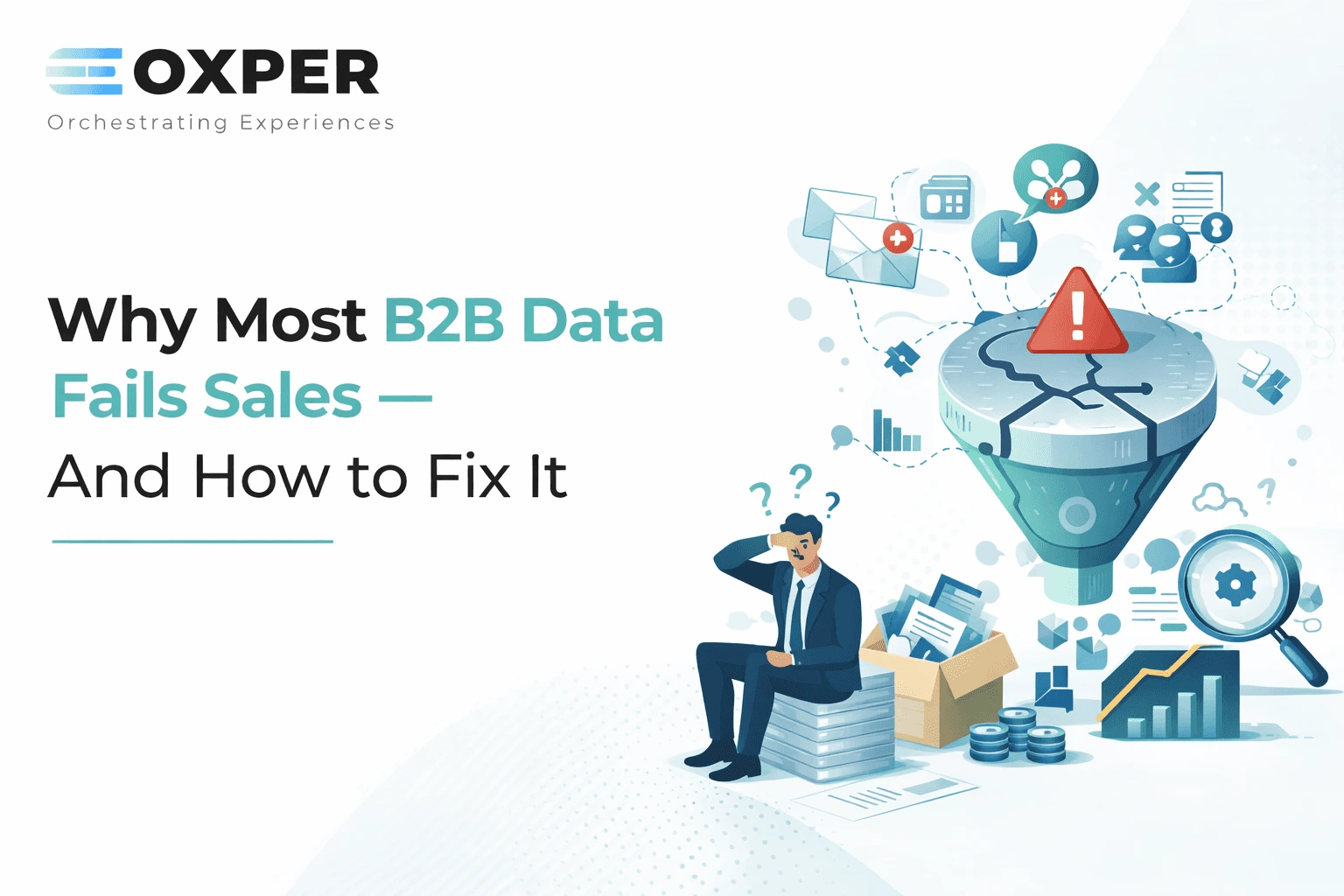
It’s the B2B Data.
When the underlying data is weak, everything built on top of it becomes inefficient. Marketing campaigns reach the wrong people. Sales teams waste time filtering prospects. Pipeline reports look healthy while actual revenue lags behind.
For many B2B companies, improving data quality turns out to be one of the fastest ways to improve sales performance.
The Problem Nobody Talks About in B2B Marketing
Most companies believe they already have enough data.
After all, their CRM may contain thousands of contacts. Data vendors keep adding new lists. Marketing automation tools collect behavioural signals every day.
On the surface, it feels like there’s plenty of information available.
But volume isn’t the same thing as accuracy.
Contacts move roles constantly. Organisations restructure. Entire buying teams change. What looked like a strong prospect database six months ago may now contain dozens of outdated records.
This is where weak B2B Data Management quietly begins affecting revenue.
Sales teams start calling prospects who are no longer responsible for the B2B buying decision. Marketing campaigns land in inboxes that no longer exist. Valuable time disappears chasing opportunities that were never real to begin with.
None of this happens dramatically. It happens slowly — which is why many organisations don’t notice the problem until sales productivity starts declining.
When Data Quality Drops, Everything Becomes Harder
Bad data doesn’t just reduce conversion rates. It affects almost every part of the revenue engine.
Marketing teams begin questioning their targeting. Paid campaigns generate clicks but few qualified opportunities. Email engagement drops even when messaging improves.
Meanwhile, sales teams become skeptical of new leads.
Reps spend valuable hours researching companies just to confirm whether a contact is still relevant. Pipeline forecasts become unreliable because the early-stage data isn’t trustworthy.
Over time, marketing and sales begin pointing fingers at each other.
But in most cases, the real culprit is simple: poor B2B Data.
What High Quality B2B Data Actually Looks Like
Not all data is equally useful.
Some datasets offer little more than basic contact details. Others provide deeper insights that help teams understand how companies actually buy.
High quality B2B data is different because it provides context, not just information.
Instead of simply listing names and emails, it reveals how organisations are structured and who participates in the B2B buying decision.
That often includes:
- Verified job roles and responsibilities
- Accurate company details and industry information
- Insights into organisational structure
- Indicators that suggest purchase interest
- Visibility into multiple stakeholders within a target account
When marketing teams work with high quality B2B data, outreach becomes far more focused. Messaging can address the priorities of different stakeholders instead of relying on one generic pitch.
And that small shift changes how prospects respond.
Why B2B Buying Decisions Are More Complex Today
Another reason poor data causes problems is that buying behaviour itself has evolved.
Years ago, B2B purchases often involved just one or two decision-makers. Today the process is rarely that simple.
Most B2B buying decision processes involve multiple departments — operations, finance, IT, procurement, and senior leadership.
Each stakeholder views the purchase differently.
Operations may care about efficiency. Finance evaluates cost. IT focuses on compatibility. Leadership looks at long-term business impact.
If marketing campaigns only reach one of those people, the rest of the buying group remains outside the conversation.
This is why many organisations now rely on specialised B2B data services that map entire buying committees instead of identifying a single contact.
It’s no longer enough to know who works at a company. Teams need to understand who influences the purchase.
How Successful Companies Fix Their B2B Data Strategy
Companies that consistently generate strong pipelines tend to approach data differently.
They treat it as a core growth asset rather than a marketing tool.
Here are three shifts that usually make the biggest difference.
1. They Focus on Accounts Instead of Isolated Leads
Instead of targeting individuals randomly, successful teams study high-value accounts in detail.
This allows marketing efforts to reach multiple stakeholders involved in the B2B buying decision.
Account-based marketing strategies depend heavily on high quality B2B data to identify those stakeholders.
2. They Continuously Improve Data Accuracy
Business data deteriorates faster than most organisations realise. Job changes alone can invalidate large portions of a database each year.
That’s why many companies use specialised B2B data services that continuously enrich and validate records.
3. They Align Data With Revenue Strategy
Strong B2B Data Management connects marketing and sales around shared account insights.
Instead of focusing on raw lead numbers, teams prioritise the companies most likely to convert.
This makes pipeline activity more predictable and improves sales productivity.
How Oxper Helps B2B Brands Turn Data Into Revenue
For many organisations, fixing their data ecosystem internally can be overwhelming.
It requires strategic planning, analytics expertise, and close collaboration between marketing and sales teams.
Oxper works with B2B brands to simplify that process.
Rather than running isolated marketing campaigns, the agency builds integrated growth systems powered by accurate data.
Through services like Account Based Marketing, SEO, Lead Generation, Social Media Marketing, Performance Marketing, and Marketing Automation, Oxper helps companies activate high quality B2B data across the entire buying journey.
The goal isn’t just generating more leads.
It’s ensuring that marketing efforts reach the stakeholders who actually influence the B2B buying decision.
When that alignment happens, marketing stops feeling like an expense — and starts functioning as a true revenue driver.
The Real Takeaway: Better B2B Data Drives Better Sales
Marketing technology will continue evolving. Automation platforms will become smarter. Analytics tools will generate deeper insights.
But none of that matters if the underlying B2B Data is flawed.
Companies that prioritise high quality B2B data, strengthen their B2B Data Management, and leverage reliable B2B data services consistently outperform competitors who rely on outdated contact lists.
Because in B2B growth, success rarely comes from reaching more prospects.
It comes from reaching the right people involved in the B2B buying decision.
If your pipeline feels busy but deals are slow to close, the problem may not be your sales strategy.
It may simply be the data powering it.
Oxper helps B2B brands transform fragmented marketing data into predictable pipeline growth.