Introduction: The Uncomfortable Truth About ABM
Account-based marketing has become the buzzword of modern B2B growth. Every agency claims to run sophisticated ABM campaigns. Every SaaS brand says it has an ABM strategy. LinkedIn feeds are full of ABM success stories.
Yet behind the scenes, a different reality exists.
Many companies invest months building account lists, creating personalized content, and running targeted ads—only to see minimal pipeline impact. Sales teams complain that the leads aren’t qualified. Marketing teams argue that sales never followed up. Leadership begins questioning whether ABM actually works.
The problem isn’t the concept.
When executed properly, ABM campaigns can increase deal sizes, accelerate sales cycles, and create deeper relationships with high-value accounts. But most campaigns fail long before they even reach the target account.
Why?
Because the strategy, alignment, and execution behind them are often flawed.
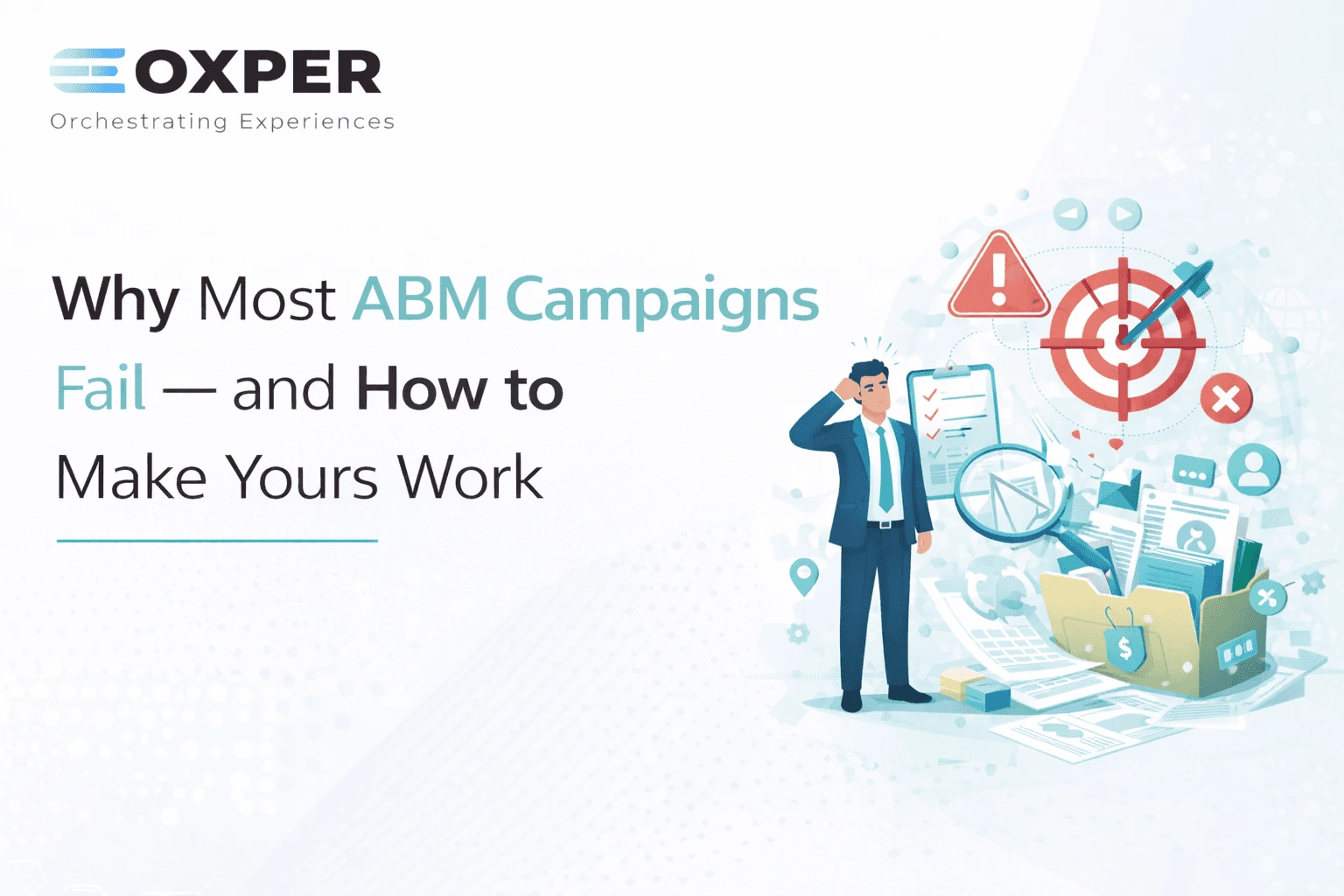
Let’s unpack the real reasons why ABM campaigns fail—and what successful B2B companies do differently.
The Hidden Problem: ABM Without Strategy
One of the most common mistakes companies make is jumping into ABM without a clear B2B ABM Framework.
Many marketing teams treat ABM like a tactic rather than a strategic approach. They buy a data list, run LinkedIn ads, send personalized emails, and assume they are doing ABM.
But true account-based marketing is not a campaign.
It’s a coordinated growth strategy.
A structured B2B ABM Framework defines:
- Which accounts matter most
- Why those accounts are strategically valuable
- What insights drive personalization
- How marketing and sales collaborate to engage them
Without this structure, ABM campaigns quickly become scattered marketing experiments rather than focused revenue initiatives.
The result? Low engagement, confused messaging, and a pipeline that barely moves.
Misaligned Sales and Marketing Teams
Another major reason ABM campaigns fail is poor Sales and Marketing Alignment.
ABM requires both teams to operate as a single revenue unit. But in many organizations, marketing and sales are still working with completely different priorities.
Marketing focuses on generating engagement.
Sales focuses on closing deals.
Without strong Sales and Marketing Alignment, this disconnect creates friction at every stage of the funnel.
For example:
Marketing might target accounts that look ideal on paper but don’t fit sales’ real-world experience.
Sales might ignore leads generated from ABM campaigns because they weren’t involved in defining the accounts.
The most successful ABM initiatives start with shared planning sessions where both teams agree on:
- Target account lists
- Buying committee personas
- Engagement signals
- Follow-up processes
When Sales and Marketing Alignment improves, ABM transforms from a marketing activity into a true revenue engine.
Targeting Too Many Accounts
Ironically, many companies sabotage their own ABM campaigns by trying to scale too quickly.
ABM is designed for precision—not volume.
Some organizations target hundreds or even thousands of accounts in their first campaign. The result is superficial personalization and generic messaging.
Instead of feeling highly relevant, the outreach feels automated.
A smarter ABM strategy focuses on a smaller group of high-value accounts and goes deeper with engagement.
Effective ABM strategies often follow a tiered approach:
Tier 1 – Strategic Accounts
Highly personalized campaigns involving custom content, executive outreach, and tailored messaging.
Tier 2 – High-Value Accounts
Segment-based personalization using industry insights.
Tier 3 – Scaled ABM
Automation-driven campaigns with data-informed targeting.
This layered approach allows companies to create meaningful engagement while maintaining efficiency.
And most importantly—it drives real ABM Pipeline Growth.
Weak Personalization That Feels Automated
Personalization is the heart of successful ABM campaigns.
Yet many companies mistake basic customization for genuine relevance.
Simply inserting a company name into an email does not make a campaign personalized.
True ABM personalization requires understanding the account’s business priorities, industry pressures, and decision-making dynamics.
For example:
Instead of sending generic messaging about “improving marketing performance,” an ABM campaign could highlight how a specific company’s competitors are adopting AI-driven demand generation strategies.
This level of relevance immediately captures attention.
Strong ABM strategies rely on deep research, intent data, and strategic insights to craft messaging that feels genuinely tailored.
When done well, personalization builds trust—and trust accelerates deals.
Measuring the Wrong Metrics
Another reason ABM campaigns fail is that companies track the wrong metrics.
Traditional marketing metrics like impressions, clicks, and downloads don’t fully capture the value of ABM.
Instead, successful teams focus on indicators of ABM Pipeline Growth, such as:
- Account engagement levels
- Buying committee participation
- Opportunity creation
- Pipeline velocity
These metrics reveal whether target accounts are moving closer to purchase decisions.
Organizations that monitor ABM Pipeline Growth gain clearer insights into what messaging works, which accounts are warming up, and where sales should focus their attention.
The Missing Piece: A Proven ABM Execution Partner
Designing and executing effective ABM campaigns requires more than tools and automation platforms.
It demands strategy, research, creative messaging, and cross-channel execution.
This is where partnering with a specialised account based marketing agency becomes valuable.
An experienced account based marketing agency understands how to:
- Build a scalable B2B ABM Framework
- Align sales and marketing teams around shared goals
- Develop high-impact ABM strategies
- Execute targeted campaigns across digital channels
Agencies also bring a critical external perspective. They can identify gaps in messaging, audience targeting, and sales enablement that internal teams often overlook.
For companies serious about driving ABM Pipeline Growth, working with a strategic partner dramatically accelerates results.
Why B2B Brands Partner With Oxper
Oxper helps B2B companies design and execute high-performing ABM campaigns that generate measurable pipeline growth.
Unlike traditional marketing agencies, Oxper approaches ABM as a complete revenue strategy.
Their integrated services include:
- Account-Based Marketing (ABM) strategy development
- Target account research and segmentation
- Cross-channel campaign execution
- Sales enablement and personalization frameworks
- Marketing automation and pipeline analytics
By combining ABM strategies, performance marketing, SEO, and marketing automation, Oxper helps companies build scalable systems for ABM Pipeline Growth.
If your organization is struggling to convert high-value accounts, a structured ABM strategy can transform your revenue trajectory.
Explore Oxper’s account based marketing agency solutions to see how strategic ABM can unlock your next stage of growth.
Conclusion: The Future of B2B Growth Belongs to ABM
Despite the hype, ABM campaigns remain one of the most powerful growth strategies in B2B marketing.
But success requires more than personalization and targeted ads.
It requires strategy.
It requires alignment.
And it requires the discipline to focus on the accounts that matter most.
Companies that implement a strong B2B ABM Framework, build deep Sales and Marketing Alignment, and execute data-driven ABM strategies consistently outperform competitors.
The question isn’t whether ABM works.
The real question is whether your organization is executing it the right way.
If you’re ready to build smarter ABM campaigns and drive predictable ABM Pipeline Growth, partnering with Oxper could be the strategic advantage your business needs.