Marketing leaders in B2B companies are often pulled in two directions.
On one side sits performance marketing — measurable, fast, and often persuasive when quarterly targets loom. On the other side is growth marketing — slower to build, but capable of creating real market momentum.
The tension between these two approaches shows up in boardrooms, planning sessions, and budget reviews. One team argues for scaling ads because they drive immediate leads. Another insists the company needs a broader demand engine built on content, brand authority, and long-term strategy.
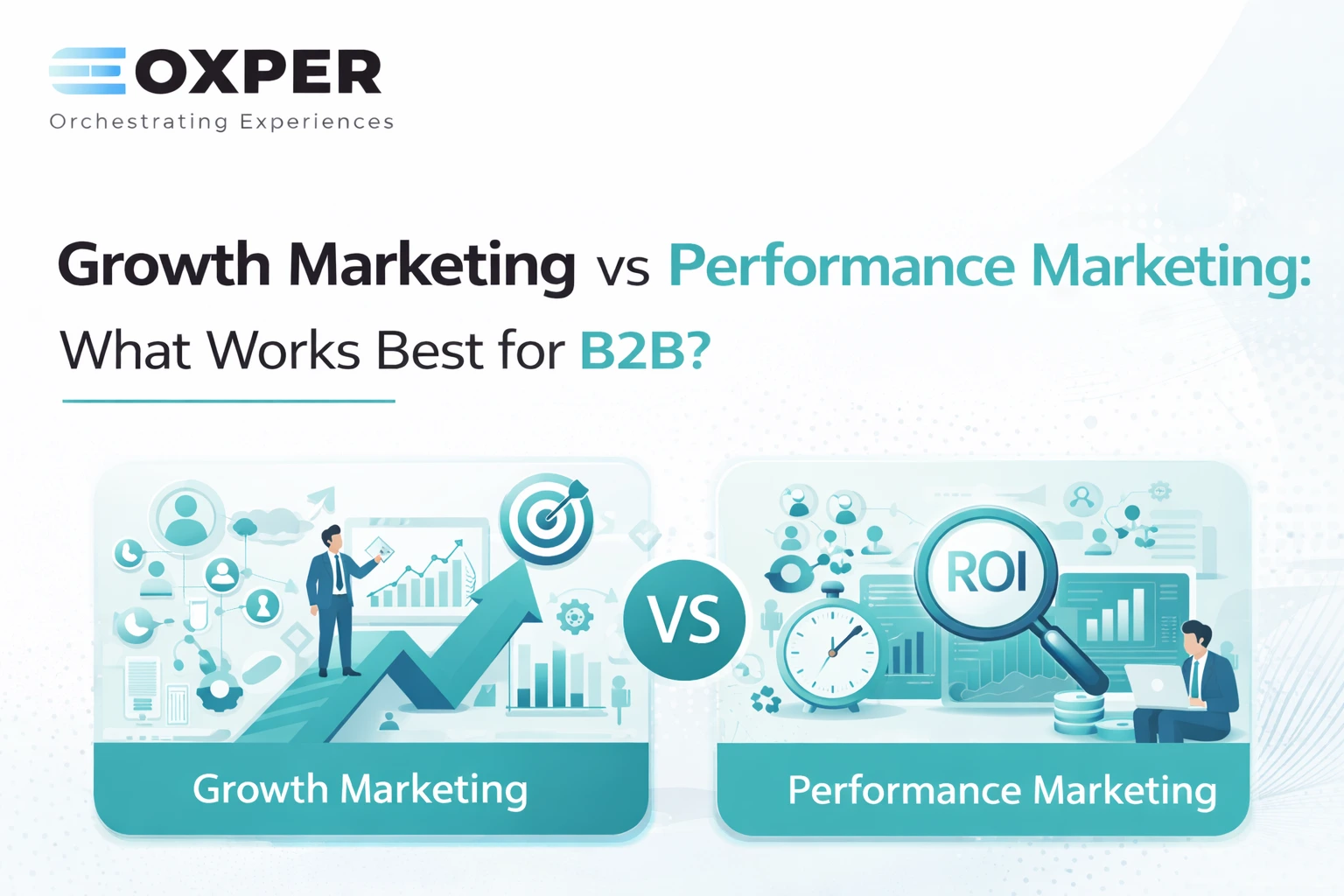
The debate around Growth Marketing vs Performance Marketing isn’t just theoretical. It reflects a real challenge facing many B2B organisations today: how to balance short-term results with long-term growth.
And in the B2B industry, where deals involve multiple decision-makers and longer sales cycles, that balance becomes even more critical.
Growth Marketing: Building the Engine, Not Just the Campaign
The easiest way to understand Growth Marketing is to think of it as infrastructure.
Performance marketing launches campaigns. Growth marketing builds systems.
A seasoned B2B growth marketing agency doesn’t just ask how to generate leads this quarter. It asks a more strategic question: How do we create predictable demand for the next three years?
That shift in perspective changes everything.
Instead of relying heavily on paid acquisition, growth marketing expands the marketing ecosystem. SEO becomes a strategic investment. Content becomes a trust-building mechanism. Social media becomes a platform for thought leadership rather than just promotion.
For instance, a company targeting enterprise clients might build visibility through:
- industry-focused SEO content
- insights shared by executives on LinkedIn
- marketing automation that nurtures prospects over time
- carefully designed Account-Based Marketing campaigns targeting priority companies
None of these elements deliver instant gratification. But together, they form a powerful growth engine.
That’s why Growth Marketing often appeals to experienced B2B leaders who understand that sustainable demand rarely comes from a single campaign.
Performance Marketing: The Acceleration Layer
Now let’s shift gears.
While growth marketing builds the foundation, Performance Marketing acts as the accelerator.
Its appeal is obvious. Campaigns launch quickly, results appear in dashboards within days, and marketing teams can scale budgets based on performance data.
This is why many performance marketing companies focus on platforms where attribution is clear and optimisation happens rapidly:
- Google Ads
- LinkedIn advertising
- retargeting campaigns
- programmatic display advertising
For B2B organisations, performance marketing is particularly useful when entering new markets or promoting a specific product line.
Need to test messaging with manufacturing CIOs? Launch LinkedIn campaigns.
Want to capture high-intent searches? Invest in Google Ads.
The model works — sometimes exceptionally well.
But over time, many companies discover something uncomfortable: performance marketing can become expensive when it’s the only strategy in place.
Ad costs rise. Competitors enter auctions. And customer acquisition becomes increasingly dependent on paid media.
This is exactly where the conversation around Growth Marketing vs Performance Marketing becomes more nuanced.
Growth Marketing vs Performance Marketing: The Real Difference
It’s tempting to treat these two approaches as competitors. In reality, they operate on different timelines.
Performance marketing is tactical. Growth marketing is structural.
Performance campaigns focus on capturing existing demand. Growth marketing focuses on creating demand.
Another difference lies in how each approach views the marketing funnel.
Performance marketing usually targets prospects already researching solutions. The campaigns aim to convert attention into leads.
Growth marketing expands the funnel much earlier. It influences buyers while they are still forming opinions, reading industry insights, or evaluating future investments.
In the B2B industry, that early influence matters more than many marketers realise.
A CIO who reads your insights for six months is far more likely to trust your brand when procurement conversations begin.
Why Smart B2B Leaders Combine Both
The most successful B2B organisations rarely rely on a single marketing philosophy.
Instead, they treat growth marketing and performance marketing as complementary forces.
Imagine a company selling automation solutions to large manufacturers.
Their marketing strategy might include:
- SEO-driven content answering operational challenges
- LinkedIn thought leadership building credibility among engineers and operations leaders
- Account-Based Marketing campaigns targeting strategic accounts
- performance marketing campaigns promoting webinars or product demos
Performance campaigns capture immediate opportunities. Growth initiatives strengthen brand authority over time.
Together, they create a demand engine that evolves with the market.
For many B2B leaders, this hybrid model becomes the most practical way to navigate the complexities of the modern B2B industry.
Where Account-Based Marketing Fits
One of the reasons Account-Based Marketing has gained traction is that it naturally bridges growth and performance strategies.
Rather than casting a wide net, ABM focuses on a curated list of high-value companies. Marketing and sales teams align around these accounts, delivering personalised messaging and targeted outreach.
For example, a technology provider targeting global logistics firms might combine:
- tailored LinkedIn campaigns
- personalised landing pages
- industry-specific content
- automated nurturing workflows
This approach reflects a broader evolution in B2B marketing. Precision matters more than reach.
And when executed well, Account-Based Marketing strengthens both growth and performance initiatives.
How Oxper Helps B2B Organisations Navigate This
Many companies attempt growth marketing and performance marketing simultaneously — but struggle because the pieces don’t connect.
Ads generate leads, yet the website doesn’t convert.
Content attracts traffic, yet prospects never move toward sales conversations.
This fragmentation is common.
Oxper approaches the problem differently.
As a strategic B2B growth marketing agency, the focus is not just on campaigns but on the architecture behind them.
The team works with B2B organisations to design marketing ecosystems where:
- SEO generates sustained organic visibility
- performance marketing drives targeted demand
- Account-Based Marketing reaches high-value accounts
- marketing automation nurtures prospects intelligently
- UX design improves conversion rates across digital assets
The goal isn’t simply more traffic or more leads. It’s a marketing system that consistently moves prospects from curiosity to conversation.
Final Thoughts
The conversation around Growth Marketing vs Performance Marketing often frames the two as opposing strategies.
But in practice, the most effective marketing organisations treat them as partners.
Performance marketing delivers speed.
Growth marketing delivers resilience.
In the long run, B2B leaders who invest in both approaches tend to build stronger brands, deeper customer relationships, and more predictable pipelines.
For companies navigating competitive markets in the modern B2B industry, that balance can make all the difference.
If your organisation is looking to move beyond isolated campaigns and build a structured demand engine, Oxper’s growth-focused marketing approach can help turn strategy into measurable results.