Then there is the silence in the quarterly review meeting. The marketing deck is presented. There’s 1,400 leads, a 34% increase in traffic, engagement numbers doing well. And the CEO asks only one question: how many of those turned into revenue?
There are no immediate responses. Someone says the sales cycle is long. Another brings up attribution problems.
This pause — not any proposal — determines the fate of most agency engagements.
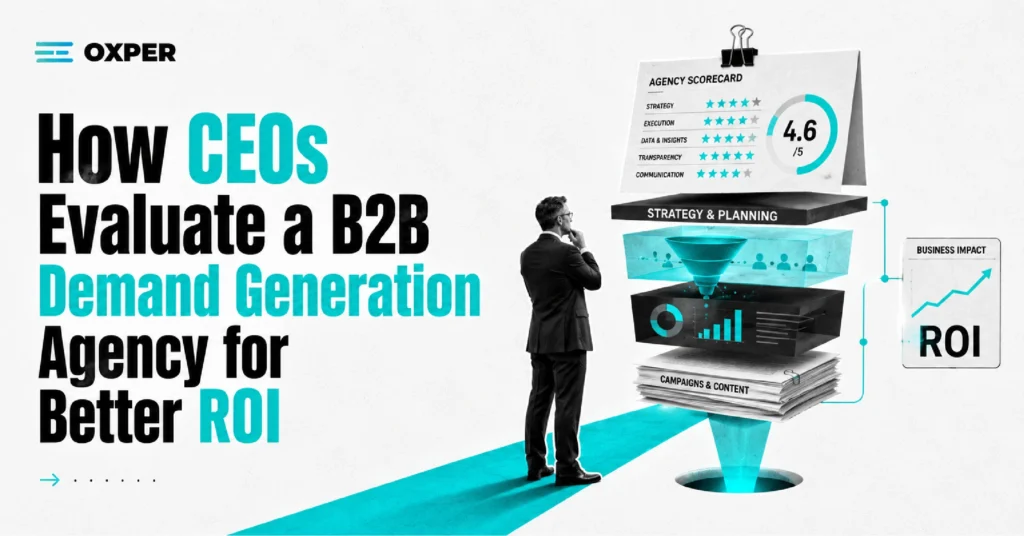
There is a reason why the metrics by which a CEO will judge an agency are different from the metrics by which a CMO will judge that same agency. And when the CEO walks into the agency selection meeting for the B2B demand generation agency, he or she doesn’t ask many questions. And the ones asked can be quite tough to answer through dashboards.
This is the view through that lens.
CEOs are not buying leads. They are buying predictability.
That’s precisely what gets misunderstood time and again by agencies. A CEO doesn’t really care about getting more leads; what she cares about is being able to truthfully tell her board that “if we invest X in demand generation in Qn+1, we will see Y of qualified pipeline 90 days from now.”
Predictability – that’s the real product here.
And that’s why a B2B demand generation agency that starts with “our team will increase your MQLs by 40%” talks in the wrong language all together. Having 40% more of whatever people don’t buy is not growth; it is just plain waste of money.
The CEO’s way of looking at it would sound something like: what’s our cost per qualified opportunity, is it decreasing or increasing, and when will this investment pay off?
The four numbers that decide everything
If you ask the CEO of a company how she gauges the ROI of demand generation efforts, you will probably hear a variant on one of these four:
- CPL vs CPA. Cost per lead is probably the easiest measure of return on investment in marketing to a game. Remove your gate, execute a wider campaign, purchase a list, and CPL will melt while the pipeline doesn’t move. CPA is much more difficult to manipulate.
- Payback period of CAC. It takes x number of months worth of gross margin to recoup your customer acquisition costs. In 2026, median values in B2B will likely be between 15 and 18 months, and top quartiles will recover their costs in less than 12 months. But the CEO shouldn’t know her own number. The agency should.
- Marketing pipeline contribution. What percentage of the pipeline was generated through marketing contacts? There is a wide range of benchmarks depending on the GTM model, but consistently below 30% almost always means that the investment in marketing is either too low or not properly allocated.
- Speed to close. Do deals coming from the agency move faster or slower compared to the company average? If slower, then the targeting is probably wrong, regardless of volume.
See what is missing here. Impressions. Reach. Subscribers. Because they matter, but they are input metrics, and it is the CEO’s job to think about output metrics.
How to evaluate a demand generation agency: what to actually test
Most of the evaluations tell you what questions to ask. Helpful, yet still not complete, as any sales representative knows exactly how to respond to your questions. The differentiating factor for agencies is what they do, not what they say.
Here’s a more useful guide to evaluating a demand generation agency.
Ask for failures. Every agency has plenty of case studies for you. Instead, ask them to talk about an account that failed and what measures they took to fix it. Only those agencies who are willing to give you a detailed response can boast experience in running such programs until they face problems. Being vague on this one is completely unacceptable.
See if they require your closed-won data. Competent B2B demand generation services start with your most successful clients, and go backwards to identify similar ones. If an agency suggests starting off with channel strategies and skipping your CRM, it means they are only guessing.
See how comfortable they are with selling. Demand generation either succeeds or fails on the hand-off. If the agency has never been in a sales meeting, hasn’t asked about your SDR follow-up service level agreement, hasn’t challenged your lead scoring system – those leads are going into a CRM to languish.
See what kind of contract structure they use. An agency with confidence in itself will take on a set period with set metrics for success. If they ask you for twelve months upfront with no midway assessment – they’re protecting themselves, not you.
Who really does the work? The strategist you hear from during the pitch isn’t always the one you’re working with. This is the most common reason people are disappointed in agencies and all it takes is asking one question.
What a realistic ROI timeline looks like
We need to be frank about one of the things the business likes to overlook.
ROI on demand generation does not occur within 30 days. If you get any promises of pipeline within the first 30 days without having a database in place, they either have been buying lists or lying, and both scenarios are destined to fail.
An honest curve would look like this:
| Phase | Timeline | What good looks like |
| Discovery, ICP and data audit | Weeks 1–4 | Clear ICP, agreed lead definitions, tracking fixed |
| Build and launch | Weeks 4–8 | Campaigns live, CRM integrated, baselines set |
| Early signal | Months 2–3 | Engagement quality, sales acceptance rate improving |
| Pipeline ramp | Months 4–6 | Cost per opportunity trending down |
| Compounding returns | Month 6+ | Organic and ABM assets reduce blended CAC |
The danger is evaluating the program at month two, when data is limited, and the temptation to freak out is greatest. The opposite danger – waiting a full year before evaluating – is even greater.
Month three is the honest time. It’s not “did we close deals,” but rather “are leads getting better?”
Where Oxper fits
We specialize in working with manufacturers, industrial, chemicals, and technology companies – sectors in which there is a big technical and skeptical buying committee, and where a lead is worth nothing until it has been qualified by a sales engineer.
That is why our approach as a demand generation agency for B2B is what it is. We begin from your closed-won data, not a channel strategy. We define what a qualified lead looks like for you with your sales team before anything else. And we measure pipeline contribution, because it is the figure your CEO will want to know anyway.
The marketing programs we run in relation to our account based marketing strategy focus more on specific named accounts as opposed to volume. The SEO and content efforts we do create the layer of compounding value that brings down the blended acquisition cost over time – for instance, in one case, we managed to increase organic traffic by 90% and keywords on page one by 300%. This is the type of value that goes beyond campaigns.
If you are comparing us to another B2B marketing firm when it comes to lead generation, ask us both the five questions above.
The decision is simpler than it looks