The legitimate reality about GEO and AEO in 2026 suggests that while traffic is still low and there are discrepancies in measurements, companies that assure AI ratings are relying on pure speculation only.
Actually, traffic from this source is the topmost quality, which presupposes that companies that operate GEO and AEO nowadays will hardly lose their positions within a few months. Citation benefit is accumulating – this is basically a single idea here.
If you consider waiting until the values are high enough to take action, the delay will mean that you will arrive when your competitors have already taught the model.
Book your GEO and AEO audit with Oxper today – we will conduct an analysis of your buyer prompt across the most popular AI platforms and find out what they think about you now.
Your buyer built a shortlist. You were not in the room.
A major obstacle that modern B2B sales representatives face is that evaluations are conducted even before contact with potential customers, with research from 6sense suggesting that approximately 70% of the buying process is complete before a form is filled out.
Nevertheless, AI technology or chatbots are being incorporated into the process. Approximately 50% of B2B software buyers report that vendor research begins with an AI chatbot rather than a search engine, while Gartner experts predict that by 2028, most B2B purchases will use AI agents.
Thus, a vendor’s shortlist is created during the conversations that one cannot join. If your company is unknown to AI, it will not be able to analyze the company’s website or find third-party information confirming your company’s trustworthiness, and thus, your business will not enter this shortlist – with no input, leads would not receive any data.
This unfortunately is a problem that is less about SEO and more about demand generation. This means that today’s demand generation strategies must incorporate the so-called “invisible research” stage.
What GEO AEO actually means (and what it does not)
These two concepts are often misrepresented and interchangeable.
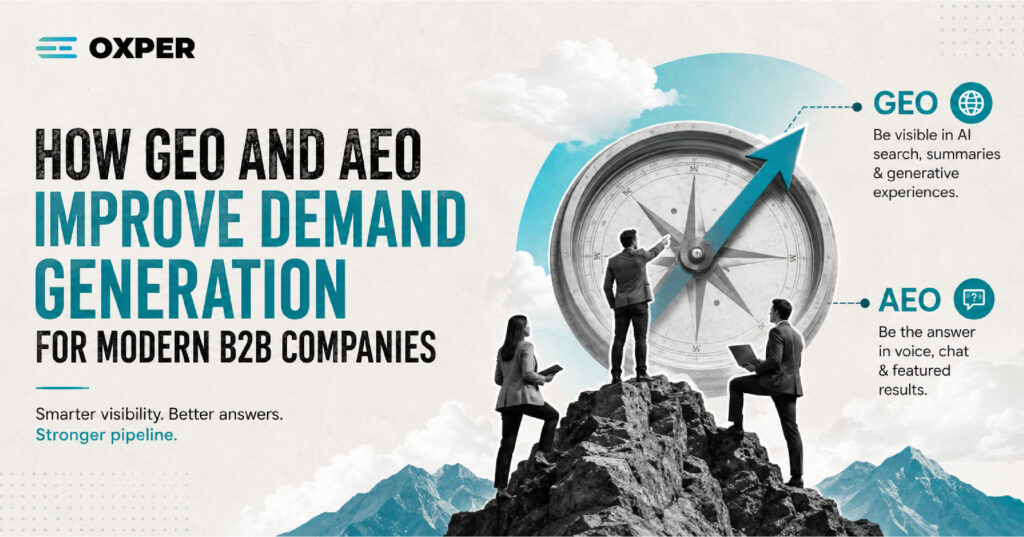
AEO stands for “answer engine optimization” in B2B and involves answers being directly pulled into answers like nowadays AI-generated snippets called “People Also Ask”. It also comes with “perks” of clear content, structure, and use of definition tables and specifications.
GEO is a more complex concept that means that large language models will interpret your brand. It is less connected to the home page and more to what is said about your brand online.
So, to explain it to CMOs AEO is about being quoted while GEO is about making recommendations. In actuality, you need both and that is why they are combined under GEO AEO.
And this is not simply a new label for SEO. In fact, while SEO focuses on rankings, B2B AI search optimization makes its attention more on synthesis and references.
The numbers B2B leaders should care about
I’m usually not a big fan of data overload, but there is still such kind of data that will help you in budgeting.
Referral traffic from the AI still remains low—averaging from 1 to 2% of total traffic for an average B2B company. Due to this fact, this not only gets neglected but brings the wrong conclusions.
As per the Semrush report of 2026, traffic generated by AI sources converts four times more compared to ordinary organic traffic.
According to Seer Interactive, businesses in the B2B space show conversion of 15.9% for visitors coming from ChatGPT as opposed to 2% from organic traffic coming from Google.
The Adobe report for the first semester of 2026 states that companies that generate traffic through AI sources manage to prove this traffic by 393% year-on-year.
The reason for this discrepancy is that the model has already done the qualification. It has performed comparison, filtering, and confirmed your reliability. Such a user is already invited thanks to a trusted third party. Thus, such users behave more like warm prospects than organic visitors.
Small channel. Large pipeline. This is how one would define early advantages of this type.
Five things that actually get B2B brands cited
That’s enough of the theory. This is where the majority of both GEO and AEO services earn their fees — or else do absolutely nothing.
- So let’s get to the point in the first 40 words. When it comes to models, the process of lengthy, rambling introductions can be eliminated. The direct answer should be the first thing in the section, with the explanation following. This won’t look good for brand authors but will provide excellent results when it comes to citation.
- Create content with comparisons and alternatives, even on issues where you lose. Customers want to get comparisons from AI. If there are comparison pages created by competitors only, you can really guess what the overall outcome will be. It is proved that “X vs. Y”, where the authors provide honest information, will be quoted much more.
- Make your entity not only right but also consistent. Reliable NAP information, correct schema layer, Organization markup describing how you operate. These will definitely count among criteria used while building entity graphs. If you have contradictory information, this will make you appear unreliable.
- Chase didn’t only win backlinks; it also received mentions. Analysis conducted through 2026 has shown that a low percentage of web pages found in AI Overviews make it to the top ten of organic search results. Mentions appear on review sites, industry magazines, threads, and third-party listicles. Digital PR has just quietly become a ranking factor once again.
- Make your content machine-readable: make H2s as questions, use structured data, opt for tables instead of paragraphs for specifications, and keep your pages both old and fresh. Therefore, it is more relevant.
Add these ideas, and most of the things that are sold as complicated AI search optimization for B2B companies will boil down to educated content architecture.
How do you measure something that does not send a click?
Most companies find this to be the most complicated section, which is quite understandable as companies are still figuring out how to utilize the measurement layer.
Begin with simplicity. Instead of assigning AI referral traffic in GA4 (chatgpt.com, perplexity.ai, gemini, copilot) to “direct” or “referral” traffic like many companies do, do a better classification and assign them a new traffic channel group. Next, look at share of voice by picking a set of 30-50 buying-intent searches every month and check frequency of mentions of your business, how your company is assessed, and which other brands are named alongside yours.
The second metric is most interesting in this case as it is easy to be mentioned, but it is more important how. I have spotted companies mentioned on many occasions but totally mispositioned, which means that they are seen as niche players while in fact they belong to the enterprise sector or they have features made obsolete a couple of years ago.
AI answers provide brand sentiment and framing so that it can serve the purpose of brand tracking. There are very few companies using such data in B2B lead generation.
Where Oxper fits
Almost all agencies are selling AI search as a add-ons. We think that is backwards.
At Oxper, GEO AEO sits in the demand engine not next to it. The SEO practice does the technical and entity groundwork — schema, crawlability, content restructuring for extraction. Our B2B demand generation team maps the real prompts your buyers use in each stage, then builds the content that answers them. But with more AI-referred visitors arriving along the funnel, we have designed our account based marketing and lead generation services to snag them with a suitable offer rather than the boring old “contact us” page.
We have executed this playbook in cases where the buying committee is technical, sceptical and does its homework (across margins — manufacturing, chemicals, life sciences and industrial machinery). Disciplined organic and content work increased keywords on page one by 300% for one client — organic traffic up 90%. That same rigour is what powers great GEO/AEO services today!
We will tell you first, if your website is slow, gated or one huge javascript blob. If they cannot read, models cannot cite.
The window is open. It will not stay open.
So here is my honest read: GEO AEO is like SEO circa 2009. The rules of the road are not fully established, the tooling is in its infancy and brands that go now will purchase the citation real estate which will become very expensive to reclaim down the road.
No, you really do not need a very large budget. You require a defined asset, content built for extraction, third-party recognition and the ability to determine if any of it functions.
Your buyers are already asking. The only question is whether you’re in the answer.
Do you want to understand how your brand currently presents itself in AI search? Reach out to the Oxper team – we will perform an audit of visibility across all relevant answer engines and systematically show you precisely where these gaps are present